
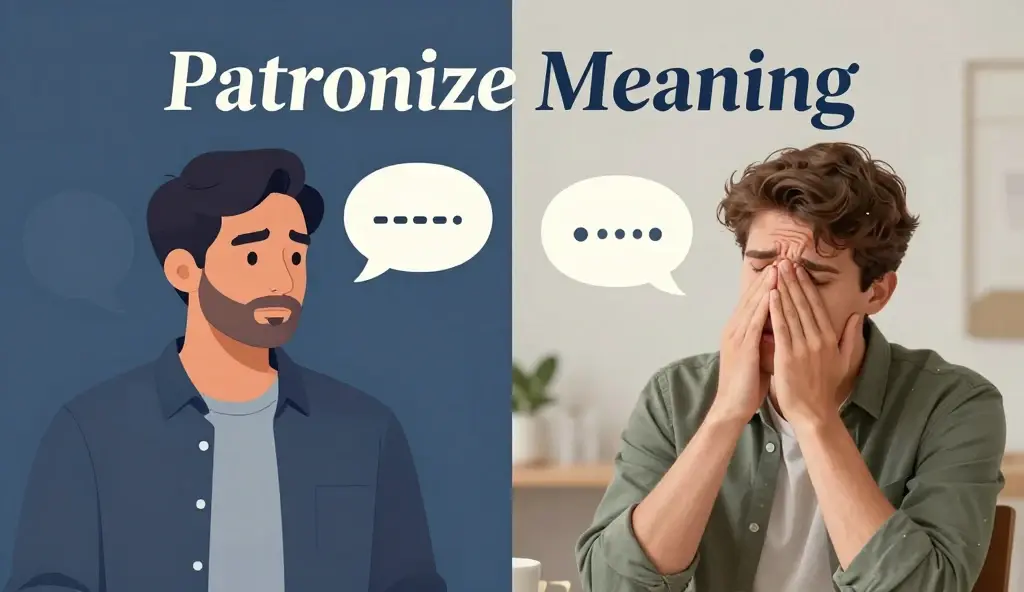
The word patronize is often searched because it has more than one meaning, and the correct meaning depends on the context.
You may see it in conversations about businesses, customer behavior, or personal interactions. Many people get confused because patronize can be either positive or negative.
Patronize means to support or be a customer of a business, person, or organization.
It can also mean treating someone in a way that seems superior, as if they are less intelligent or less capable.
The second meaning is usually negative and is common in everyday conversations.
Understanding the context is important because saying “I patronize this store” and “Don’t patronize me” have completely different meanings.
Quick Answer: What Does Patronize Mean?
Patronize has two main meanings:
- To support or regularly use a business or service
Example: “I always patronize local restaurants.” - To talk down to someone in a condescending way
Example: “Don’t patronize me.”
What Does Patronize Mean in Simple Words?
In simple English, patronize can mean either “support” or “talk down to someone.”
Positive Meaning:
To be a customer or supporter.
Example:
“I patronize small businesses.”
Meaning:
“I support and buy from small businesses.”
Negative Meaning:
To treat someone as if they are not smart enough to understand.
Example:
“She sounded like she was patronizing him.”
Meaning:
“She spoke in a way that made him feel inferior.”
What Does Patronize Mean When Talking About Businesses?
In business and shopping, patronize means to support a business by buying its products or using its services.
This is a positive meaning.
Examples:
- “Many people patronize local shops.”
- “The restaurant is popular because customers continue to patronize it.”
Meaning:
People regularly visit and support the business.
Common Business Uses:
- Patronize a restaurant
- Patronize a store
- Patronize a service
- Patronize local businesses
What Does Patronize Mean in Conversations and Relationships?
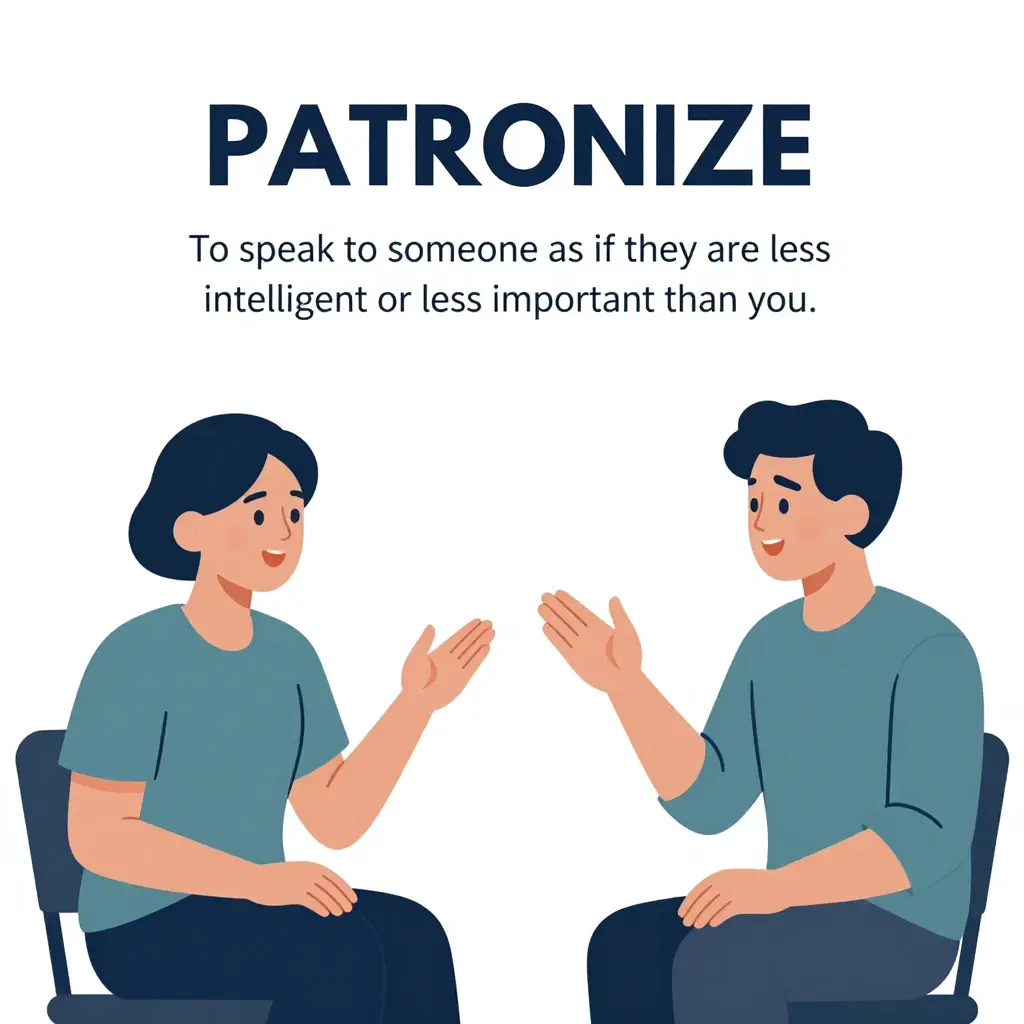
In personal conversations, patronize usually has a negative meaning.
When someone patronizes another person, they act as if they are:
- More intelligent
- More experienced
- More important
It can make the other person feel:
- Disrespected
- Ignored
- Belittled
Example:
“Don’t explain it to me like I’m a child. You’re being patronizing.”
Meaning:
“You are speaking to me as if I cannot understand.”
What Does Patronize Mean in Love and Relationships?
In relationships, patronizing behavior can create emotional distance because one person may feel undervalued.
A partner may sound patronizing when they:
- Dismiss the other person’s opinions
- Explain simple things unnecessarily
- Act superior
- Avoid listening equally
Example:
“I know you’re trying to help, but the way you explain things feels patronizing.”
Meaning:
“The tone makes me feel less respected.”
Healthy relationships usually involve:
- Mutual respect
- Equal communication
- Listening to each other
What Does Patronize Mean in Texting and Messaging?
In texting, people usually use patronize when describing someone’s attitude or tone.
Text Examples:
Person 1: Why is he explaining something obvious?
Person 2: He’s being patronizing.
Meaning:
“He is acting like others are not capable of understanding.”
Message:
“Please don’t patronize me. I understand the situation.”
Meaning:
“Please don’t talk to me in a disrespectful, superior way.”
What Does Patronize Mean in Slang and Casual Language?
In casual language, people often use “patronizing” instead of “patronize”.
Common phrases:
- “Stop being patronizing.”
- “That sounded so patronizing.”
- “Don’t talk down to me.”
These usually mean someone’s attitude feels:
- Arrogant
- Condescending
- Disrespectful
What Does Patronize Mean on Social Media?
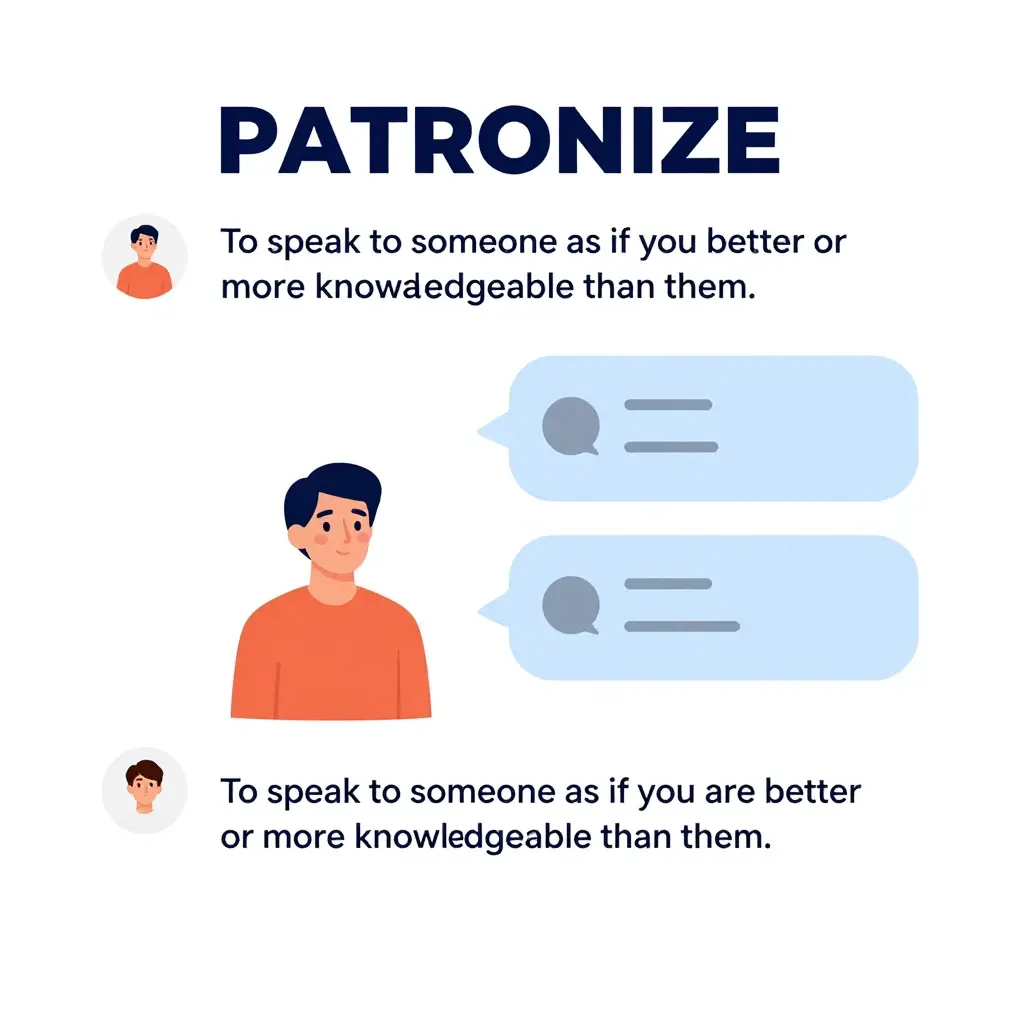
On platforms like TikTok, Instagram, Reddit, and X (Twitter), people often discuss patronizing behavior in comments and debates.
It is commonly used when someone:
- Acts like they know everything
- Talks down to others
- Gives unwanted advice
- Dismisses another person’s opinion
Social Media Examples:
Comment:
“Your reply sounds really patronizing.”
Meaning:
“Your response feels disrespectful or superior.”
Caption:
“Confidence is different from being patronizing.”
Meaning:
Being confident does not mean treating others as less important.
What Is the Difference Between Patronizing and Condescending?
These words are very similar, but there is a small difference.
Patronizing:
Usually means pretending to be kind or helpful while actually making someone feel inferior.
Example:
“Let me explain this simple thing for you.”
Condescending:
More directly means acting superior.
Example:
“You probably wouldn’t understand this.”
Both describe communication that makes another person feel looked down on.
Is Patronize a Positive or Negative Word?
Patronize can be either positive or negative.
Positive:
When talking about supporting businesses:
✅ “I patronize local shops.”
Negative:
When talking about attitude:
❌ “You are patronizing me.”
The surrounding words and situation determine the meaning.
Does Patronize Have a Spiritual or Symbolic Meaning?
Patronize does not have a specific spiritual meaning.
However, in discussions about personal growth and relationships, avoiding patronizing behavior is often connected with values such as:
- Humility
- Respect
- Kindness
- Understanding
Treating others as equals is considered an important part of healthy communication.
Does Patronize Have a Numerology or Cultural Meaning?
Patronize does not have a numerology meaning.
Culturally, the word reflects ideas about:
- Social relationships
- Power differences
- Respectful communication
- Customer support
Its negative meaning has become especially common in modern conversations about equality and communication.
Why Do People Misunderstand Patronize?
Many people know only one meaning of patronize, which causes confusion.
For example:
“I patronize this café.”
This means:
✅ “I support this café.”
But:
“Don’t patronize me.”
Means:
❌ “Don’t treat me like I’m inferior.”
The context completely changes the meaning.
How to Use Patronize Correctly
Positive Use:
✅ “I like to patronize family-owned businesses.”
Meaning:
I support them as a customer.
Negative Use:
✅ “He sounded patronizing during the meeting.”
Meaning:
His attitude seemed superior.
Avoid:
❌ Using “patronize” when you only mean “help.”
Real-Life Examples of Patronize Usage
Example 1: Business
“We encourage people to patronize local restaurants.”
Meaning:
We encourage people to support local restaurants.
Example 2: Conversation
“She felt patronized when her coworker explained an easy task.”
Meaning:
She felt talked down to.
Example 3: Online Discussion
“Don’t patronize people who have different opinions.”
Meaning:
Do not treat others as if they are less intelligent.
Example 4: Relationship
“I appreciate your advice, but please don’t patronize me.”
Meaning:
“I want respect while discussing this.”
FAQs
Q1. What does patronize really mean?
A: Patronize can mean supporting a business or treating someone in a superior, disrespectful way. The context determines its meaning.
Q2. Is patronize a bad word?
A: Not always. It is positive when it means supporting a business, but negative when it describes a condescending attitude.
Q3. What does “don’t patronize me” mean?
A: It means “don’t talk to me as if I am less intelligent, experienced, or capable.”
Q4. Is patronizing the same as being rude?
A: Yes. Patronizing behaviour is often considered rude because it can make someone feel disrespected or inferior.
Q5. What is another word for patronizing?
A: Similar words include condescending, talking down, arrogant, and dismissive.
Q6. How do you know if someone is patronizing you?
A: They may explain obvious things unnecessarily, use a childish tone, ignore your knowledge or experience, or act like they are always right.
Conclusion:
Patronize has two important meanings: supporting a business and treating someone in a superior way.
When used with businesses, it is usually positive.
When used to describe a person’s behavior, it often means someone is being condescending or disrespectful.
The key to understanding patronize is paying attention to the context.
If you see it in a conversation, online comment, or business discussion, you can now recognize what it means.
