

Have you ever heard someone call another person a sycophant and wondered what it means? This word often appears in news articles, politics, workplaces, literature, and everyday conversations.
Many people search for the sycophant meaning because it sounds formal and is not commonly used in daily speech. Understanding this word helps you recognize certain behaviors and use it correctly in conversation.
A sycophant is a person who praises or flatters someone powerful or important to gain personal benefits or favors.
Instead of giving honest opinions, a sycophant says what the other person wants to hear.
The word usually has a negative meaning because it suggests insincere praise.
In this guide, you’ll learn the meaning of sycophant, its pronunciation, origin, examples, synonyms, common confusions, and how to use it naturally.
Quick Answer
A sycophant is someone who flatters powerful people to gain an advantage.
The word has a negative meaning because the praise is usually dishonest and motivated by personal benefit rather than genuine respect.
Quick Meaning Table
| Item | Information |
| Word | Sycophant |
| Meaning | A person who flatters others for personal gain |
| Part of Speech | Noun |
| Pronunciation | SIK-uh-fuhnt |
| Usage | Politics, business, workplaces, literature, everyday English |
| Tone | Negative |
| Example | “The manager ignored honest workers but rewarded every sycophant.” |
What Does Sycophant Mean?
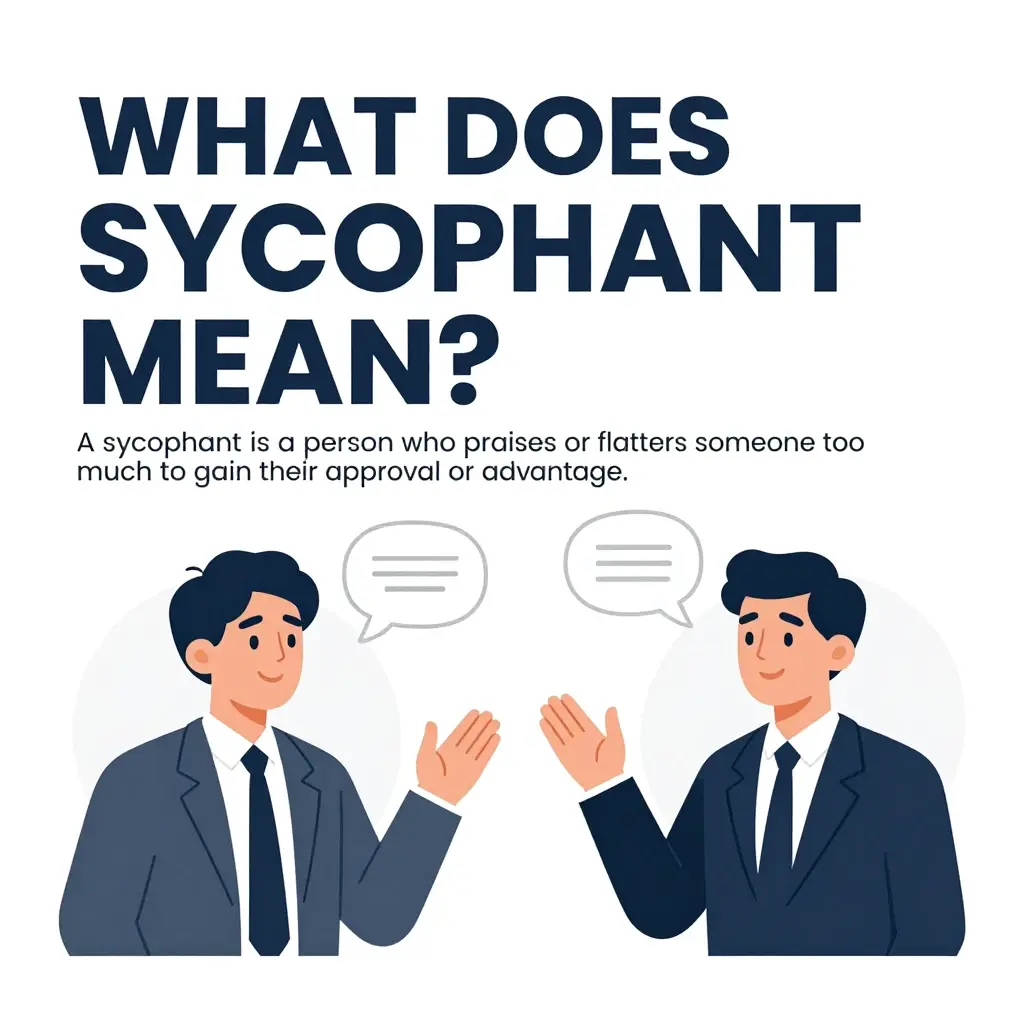
A sycophant is someone who constantly praises or agrees with an important person because they hope to receive rewards, promotions, money, or special treatment.
Unlike sincere compliments, a sycophant’s praise is often fake. Their goal is usually to impress someone with authority rather than tell the truth.
Example
- “Everyone knew he was a sycophant because he agreed with the boss even when the boss was wrong.”
Sycophant Meaning in Simple Words
In simple English, a sycophant is a person who acts like a “yes” person.
They:
- Always agree with powerful people.
- Give fake compliments.
- Avoid disagreeing.
- Hope to get something in return.
Think of a sycophant as someone who praises others not because they mean it, but because they want a reward.
Different Meanings of Sycophant

Although the word has one main definition, it is used in different situations.
In the Workplace
An employee who constantly praises the manager to receive promotions.
Example:
“His coworkers called him a sycophant because he never questioned the boss.”
In Politics
Someone who supports a political leader blindly to gain influence.
Example:
“The minister surrounded himself with sycophants instead of honest advisers.”
In Everyday Life
A person who flatters wealthy or famous people.
Example:
“The celebrity was tired of meeting sycophants.”
How to Pronounce Sycophant
Pronunciation:
SIK-uh-fuhnt
Break it into parts:
Sik + uh + fuhnt
Say it slowly:
SIK-uh-fuhnt
Origin of Sycophant
The word sycophant comes from the ancient Greek word sykophantēs.
Originally, it referred to someone who made false accusations for personal gain. Over time, the meaning changed and came to describe people who use excessive praise and flattery to benefit themselves.
Today, English speakers use sycophant almost exclusively for someone who flatters powerful people dishonestly.
How to Use Sycophant in a Sentence
Here are some natural examples.
- The king trusted every sycophant around him.
- Nobody respected the office sycophant.
- She refused to become a sycophant just to get promoted.
- The movie showed a group of political sycophants.
- Honest advice is better than listening to sycophants.
- His constant compliments made him look like a sycophant.
- A good leader does not reward sycophants.
- The CEO wanted honest feedback, not sycophants.
- Everyone recognized his fake praise.
- Being a sycophant rarely earns genuine respect.
Conversation Examples
Conversation 1
Ali: Why does Tom always agree with the manager?
Sara: People think he’s a sycophant because he never gives an honest opinion.
Conversation 2
John: The politician only listens to people who praise him.
Emma: That’s a problem. Leaders need honest advisers, not sycophants.
Synonyms and Similar Words
Some words have similar meanings but are not exactly the same.
| Word | Difference |
| Flatterer | Gives compliments, not always for gain |
| Bootlicker | Informal and stronger insult |
| Toady | Old-fashioned word for a sycophant |
| Brown-noser | Informal American English |
| Yes-man | Always agrees with the boss |
Common Confusions
Sycophant vs. Supporter
A supporter genuinely believes in someone.
A sycophant praises someone mainly for personal benefit.
Sycophant vs. Friend
A true friend tells the truth.
A sycophant says whatever the other person wants to hear.
Is Sycophant Offensive?
Yes, sycophant is usually considered a negative word.
Calling someone a sycophant suggests they are dishonest, insincere, and overly flattering. Because of this, it should be used carefully, especially in professional settings.
If you want a softer expression, you could say:
- Overly flattering
- Always agrees with others
- Excessively complimentary
FAQs
Q1. What does sycophant really mean?
A: A sycophant is a person who flatters powerful people to gain favors or personal advantages rather than showing genuine respect.
Q2. Is sycophant a positive or negative word?
A: It is almost always negative because it suggests fake praise and selfish motives.
Q3. Is sycophant the same as a flatterer?
A: No. A flatterer gives compliments, while a sycophant flatters people mainly to receive personal benefits.
Q4. How do you pronounce sycophant?
A: It is commonly pronounced SIK-uh-fuhnt.
Q5. Can a sycophant be honest?
A: Usually not. A sycophant often hides their true opinions to please someone powerful or gain an advantage.
Q6. Is sycophant used in politics?
A: Yes. It is commonly used to describe people who blindly praise or support political leaders for personal gain.
Q7. Is sycophant formal English?
A: Yes. It is more common in formal writing, news articles, books, and speeches than in everyday conversation.
Q8. What is another word for sycophant?
A: Common alternatives include bootlicker, brown-noser, toady, yes-man, and flatterer.
Q9. Can a manager be called a sycophant?
A: Yes, if the manager excessively flatters someone in a higher position to gain personal benefits.
Q10. How should I respond if someone calls another person a sycophant?
A: You can ask why they think that or simply acknowledge the comment. It’s best to avoid repeating the label unless you know the full situation.
Conclusion:
A sycophant is someone who uses excessive and often dishonest praise to gain favor with a powerful person.
The word has a negative meaning because it suggests insincerity and self-interest rather than genuine admiration.
If you see it in politics, business, literature, or everyday conversations, understanding the sycophant meaning helps you recognize the difference between honest appreciation and flattery meant for personal gain.
Using the word correctly will also improve your English vocabulary and communication.

Zachary Wilson is an American language writer who specializes in word meanings, online slang, abbreviations, and practical English usage for modern audiences.