
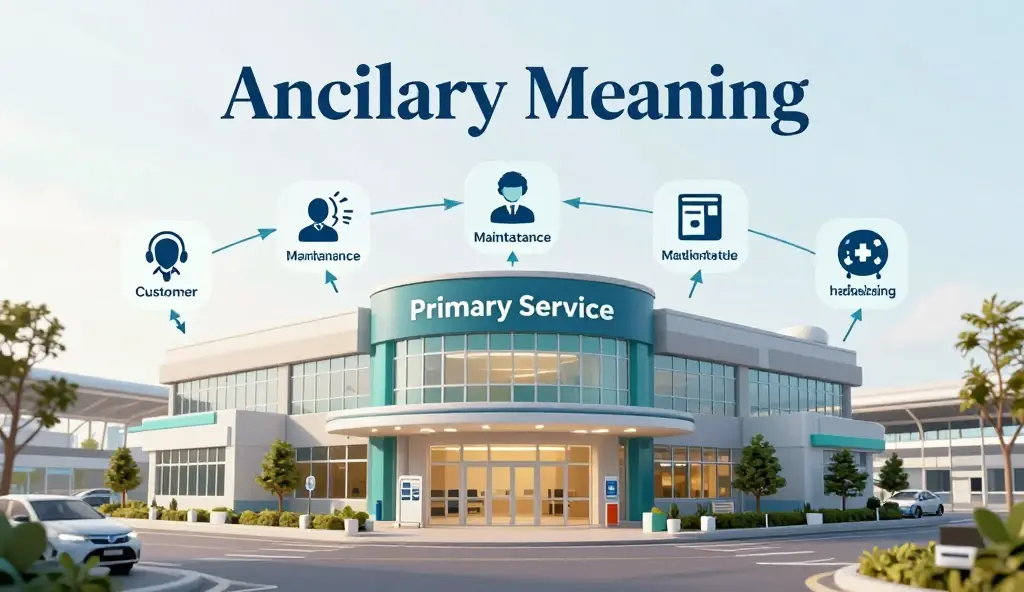
Have you ever come across the word ancillary in a business report, legal document, healthcare article, or news story? Many people search for the ancillary meaning because it is a formal English word that isn’t used in everyday conversation.
Although it may seem difficult at first, its meaning is actually quite simple.
Ancillary means providing support, help, or something additional to the main thing. It describes a person, service, product, or activity that plays a secondary or supporting role.
For example, a hospital may offer ancillary services such as laboratory testing or physical therapy to support patient care.
In this guide, you’ll learn the meaning of ancillary, its pronunciation, origin, examples, synonyms, and how to use it correctly.
Quick Answer
Ancillary means providing support or being additional to something more important.
It describes services, products, tasks, or people that assist the main activity rather than being the primary focus.
Quick Meaning Table
| Term | Ancillary |
| Meaning | Supporting, additional, or secondary |
| Part of Speech | Adjective (sometimes noun) |
| Pronunciation | AN-suh-lair-ee |
| Origin | Latin |
| Common Usage | Business, healthcare, law, education |
| Example | “The company offers ancillary services to its customers.” |
What Does Ancillary Mean?

The word ancillary describes something that supports or helps the main thing.
It is often used for:
- Services
- Products
- Departments
- Equipment
- Activities
An ancillary item is important, but it is not the main purpose.
Example
“The hotel provides ancillary services such as airport transfers and laundry.”
Ancillary Meaning in Simple Words
In simple English, ancillary means extra help or support.
Think of it as something that works alongside the main thing.
For example:
- A school cafeteria is ancillary to education.
- A printer is ancillary equipment for an office.
Different Meanings of Ancillary
The meaning stays the same, but it is used in different fields.
In Business
Ancillary services are additional services offered alongside the main product.
Examples include:
- Customer support
- Delivery
- Installation
- Maintenance
In Healthcare
Hospitals use the term ancillary services for services that support medical treatment.
Examples include:
- Laboratory tests
- X-rays
- Physical therapy
- Pharmacy services
In Law
An ancillary matter is a secondary legal issue connected to the main case.
In Education
Schools may provide ancillary services such as:
- Transportation
- Counseling
- Library services
- Technology support
How to Pronounce Ancillary
Pronunciation:
AN-suh-lair-ee
The first syllable is stressed.
Origin of Ancillary
The word ancillary comes from the Latin word ancilla, meaning female servant or maid.
Over time, its meaning developed into supporting or helping, which is how it is used in modern English.
How to Use Ancillary in a Sentence
Here are some original examples.
- The company provides ancillary services for customers.
- Hospitals depend on ancillary staff every day.
- The hotel offers ancillary facilities like a spa and gym.
- Ancillary costs increased the total price.
- The project required ancillary equipment.
- Good customer support is an ancillary service.
- The university expanded its ancillary programs.
- The clinic hired more ancillary staff.
- Ancillary information was included in the report.
- These ancillary products improve the customer experience.
Conversation Examples
Conversation 1
Emma: What are ancillary services?
Sarah: They are extra services that support the main service.
Conversation 2
Ali: Why is the laboratory called ancillary?
Ahmed: Because it supports doctors by providing important test results.
Synonyms and Similar Words
| Word | Difference |
| Supporting | Gives help to the main thing |
| Additional | Extra but not always supportive |
| Supplementary | Added to improve something |
| Auxiliary | Providing extra assistance |
| Secondary | Less important than the main thing |
Common Confusions
Ancillary vs. Auxiliary
Both mean supporting.
However, auxiliary often refers to an additional helper or backup system, while ancillary usually describes something connected to and supporting the main activity.
Ancillary vs. Supplementary
Supplementary means added to improve or complete something.
Ancillary emphasizes a supporting role rather than simply being extra.
Ancillary vs. Secondary
Something secondary is less important.
Something ancillary is specifically meant to support the main thing.
Is Ancillary a Positive Word?
Yes.
Ancillary is a neutral and professional word. It simply describes something that supports or assists the main activity. It does not have a positive or negative emotional meaning.
FAQs
Q1. What does ancillary really mean?
A: Ancillary means providing support or being additional to the main thing.
Q2. Is ancillary the same as additional?
A: No. Ancillary usually means supporting the main activity, while additional simply means extra.
Q3. What are ancillary services?
A: Ancillary services are extra services that support the main service, such as laboratory testing in a hospital or customer support in a business.
Q4. How do you pronounce ancillary?
A: ancillary (AN-suh-lair-ee) It is commonly pronounced AN-suh-lair-ee.
Q5. Is ancillary a formal word?
A: Yes. It is commonly used in business, healthcare, law, education, and professional writing.
Q6. Can ancillary be used as a noun?
A: Yes, although it is most commonly used as an adjective. As a noun, it refers to a supporting person or thing.
Q7. What is the opposite of ancillary?
A: Depending on the context, opposites include main, primary, principal, or central.
Q8. Is ancillary positive or negative?
A: Neither. It is a neutral term that describes a supporting role.
Q9. What is another word for ancillary?
A: Common synonyms include supporting, auxiliary, supplementary, and secondary.
Q10. Can ancillary describe people?
A: Yes. For example, ancillary staff refers to employees who provide support services rather than the primary service.
Conclusion:
The ancillary meaning is supporting, additional, or secondary to the main thing.
If you see the word in business, healthcare, law, or education, it usually refers to services, people, or activities that help the primary purpose.
Understanding ancillary will make it easier to read professional documents and use this formal English word correctly.
