
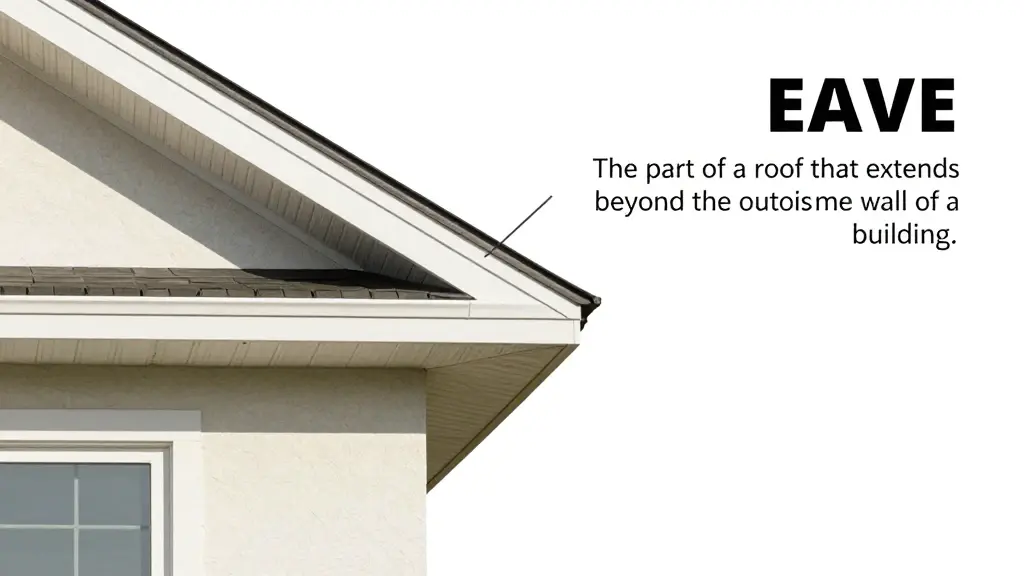
An eave is the part of a roof that extends beyond the outside wall of a building.
Eaves help protect walls, windows, doors, and the foundation from rain and snow by directing water away from the building.
The word is most often used in architecture and construction.
For example, in the sentence “Water was dripping from the eaves,” eaves means the edges of the roof that stick out beyond the walls.
You may also see the plural form eaves, which is very common because a roof usually has several projecting edges.
Quick Answer
An eave is the edge of a roof that extends beyond the outside wall of a building. Eaves help keep rain and snow away from walls and windows. The word is commonly used in architecture and construction. You will often see the plural form “eaves,” as in “rainwater ran off the eaves.”
Quick Meaning Table
| Term | Main Meaning |
| Eave | The part of a roof extending beyond a wall |
| Full form | Not an abbreviation |
| Pronunciation | eev |
| Part of speech | Noun |
| Common use | Roofing and architecture |
| Example | “Birds were nesting under the eaves.” |
What Does Eave Mean?
An eave is the part of a roof that sticks out past the exterior wall of a building.
Think of a simple house with a sloping roof. Where the roof extends a little beyond the wall, that projecting edge is an eave.
Eaves have a useful purpose. They can:
- Direct rainwater away from walls
- Help protect windows and doors
- Reduce water reaching the foundation
- Provide shade around parts of a building
- Help protect exterior walls from weather
For example:
“The rainwater ran off the eaves.”
This means the water flowed from the projecting edges of the roof.
Eave Meaning in Simple Words
In simple English:
An eave is the edge of a roof that sticks out beyond the wall.
A quick way to picture it is:
Roof → extends past wall → eave
The plural is eaves.
For example:
“The cat was sitting under the eaves.”
This means the cat was underneath the part of the roof that extends beyond the wall.
Different Meanings of Eave
Unlike many English words, eave has one main modern meaning.
1. The Edge of a Roof
An eave is the projecting edge of a roof.
“The house has wide eaves.”
This means the roof extends quite far beyond the exterior walls.
2. Eaves as a Plural Form
You will often see eaves instead of eave.
For example:
“Birds built a nest under the eaves.”
Although eave is singular, people commonly talk about the eaves because a building can have several roof edges.
Eave Meaning in Texting
Eave is not common texting slang or an abbreviation.
If someone uses eave in a text, they most likely mean the architectural part of a roof.
For example:
“The birds are nesting under the eaves.”
There is no widely recognized special texting meaning for eave.
Eave Meaning on Social Media
There is no standard social media slang meaning for eave.
On platforms such as TikTok, Instagram, Facebook, Reddit, or X, the word may appear in posts about:
- Houses
- Architecture
- Home improvement
- Roofing
- Construction
- Interior or exterior design
- Wildlife and birds
For example:
“I love the deep eaves on this house.”
Here, eaves refers to the projecting roof edges.
How to Pronounce Eave
Eave is pronounced:
eev
It rhymes with:
- Leave
- Give? ❌
- Sleeve
- Eve
- Believe
The “e” sound is long, like the sound in “Eve.”
The plural eaves is pronounced:
eevz
Origin of Eave
The word eave is very old. It comes from Old English efes, referring to the edge or border of a roof.
The word has remained connected to the projecting edge of a roof throughout its history.
The modern plural eaves is especially common in English.
Eave vs. Eaves
These words are closely related.
Eave
One projecting edge of a roof.
“The eave on the north side needs repair.”
Eaves
The plural form, commonly used when referring to the roof edges generally.
“Water is dripping from the eaves.”
In everyday English, eaves is much more common than the singular eave.
Eaves vs. Gutter
These are not the same thing.
Eaves
The projecting edge of the roof.
Gutter
A channel attached to or near the edge of a roof that collects and carries rainwater.
A gutter may be installed along the eaves.
For example:
“The gutters are attached along the eaves.”
Eaves vs. Soffit
These terms are also easy to confuse.
Eave
The part of the roof that extends beyond the wall.
Soffit
The underside of the eave or another projecting architectural structure.
So, the soffit can be part of the area beneath the eave.
Eaves vs. Roof Overhang
These terms are closely related.
A roof overhang is the amount by which a roof extends beyond a wall. The eave is the projecting edge of the roof, particularly along the lower edge of a sloped roof.
In everyday construction conversations, the terms can sometimes overlap.
How to Use Eave in a Sentence
Here are 10 natural examples:
- Rainwater was dripping from the eaves.
- The house has wide eaves that provide shade.
- Birds built a nest under the eaves.
- The contractor repaired the damaged eave.
- The eaves help keep rain away from the walls.
- Snow was hanging from the eaves.
- The old building has decorative wooden eaves.
- We noticed water stains beneath the eaves.
- The architect designed deep eaves for extra shade.
- Leaves had collected along the eaves of the roof.
Conversation Examples
Conversation 1
Alex: What are those parts of the roof that stick out?
Sam: Those are called the eaves.
Alex: What do they do?
Sam: They help keep rain away from the walls.
Conversation 2
Mia: Why are the birds sitting under the roof?
Lena: They built a nest under the eaves.
Mia: Oh, you mean the part of the roof that extends past the wall?
Lena: Exactly.
Synonyms and Similar Words
There is no perfect everyday synonym for eave, but related terms include:
- Roof edge
- Roof overhang
- Projecting roof edge
- Overhang
These words are not always technically identical.
Roof edge is the simplest general description, while eave is the specific architectural term.
Common Confusions
Is Eave the Same as Roof?
No. An eave is only a particular part of the roof—the edge that extends beyond the exterior wall.
Is Eave the Same as Gutter?
No. A gutter is a channel used to collect rainwater. An eave is the projecting edge of the roof.
Is “Eaves” Singular or Plural?
Eaves is traditionally the plural form, while eave is singular. However, “eaves” is commonly used as a general term for the projecting edges of a roof.
What Does “Under the Eaves” Mean?
“Under the eaves” means underneath the projecting edge of a roof. The phrase is often used when describing something sheltered by the roof, such as a bird’s nest or a person standing out of the rain.
Is Eave a Common Word?
It is a recognized English word, but it is more common in architecture, construction, and descriptions of buildings than in everyday conversation.
Is Eave Offensive?
No. Eave is a neutral architectural term and has no offensive meaning.
FAQs
1. What does eave mean?
An eave is the part of a roof that extends beyond the outside wall of a building. It can help protect the wall from rain and provide shade around the building.
2. What is an eave on a house?
An eave is the projecting edge of a house’s roof. It extends past the exterior wall and can help direct rainwater away from the building.
3. What is the plural of eave?
The traditional plural of eave is “eaves.” For example: “Rain was falling from the eaves.” The plural form is much more common in ordinary English.
4. What does “under the eaves” mean?
“Under the eaves” means beneath the part of a roof that extends beyond the wall. The area can provide shelter from rain and sun.
5. What is the difference between eaves and gutters?
Eaves are part of the roof, while gutters are channels that collect rainwater. Gutters are often installed along the eaves to catch water running off the roof.
6. What is the difference between eaves and soffits?
An eave is the projecting edge of a roof, while a soffit is the underside of that projecting section. A soffit can therefore be part of an eave.
7. How do you pronounce eave?
Eave is pronounced “eev.” It rhymes with words such as leave, sleeve, and Eve. The plural eaves sounds like “eevz.”
8. Why are eaves important?
Eaves help protect a building from weather. They can direct rain away from exterior walls, doors, and windows while also providing shade and reducing exposure to water.
9. What does wide eaves mean?
Wide eaves are roof edges that extend relatively far beyond the outside walls. They can provide more shade and greater protection from rain.
10. Is an eave part of the roof?
Yes. An eave is a part of the roof, specifically the edge that projects beyond the exterior wall of a building.
Conclusion:
Eave means the part of a roof that extends beyond the outside wall of a building.
Eaves can help protect walls and windows from rain while also providing shade.
The singular word is eave, but eaves is much more common in everyday descriptions.
You may also hear related terms such as gutter, soffit, and roof overhang, but these refer to different parts or features.
When you see the phrase “under the eaves,” it simply means underneath the projecting edge of a roof.

Samantha Reed specializes in English definitions, writing tips, and vocabulary improvement with clear, engaging explanations.