
Last Updated:
If someone says, “I despise dishonesty,” they mean they strongly dislike or hate dishonesty.
Despise is a verb used to describe a very strong feeling of dislike, especially when someone considers a person, action, or thing to be bad, unpleasant, or unworthy of respect.
The word is stronger than “dislike.” For example, saying “I dislike lying” shows that you do not like lying, while “I despise lying” shows a much stronger negative feeling.
You can despise a person, behavior, habit, idea, or situation.
Despise is common in everyday English, books, formal writing, and conversations.
It does not usually describe a temporary dislike.
Instead, it often expresses a deep or intense feeling of rejection or hatred toward something.
Quick Answer: What Does Despise Mean?
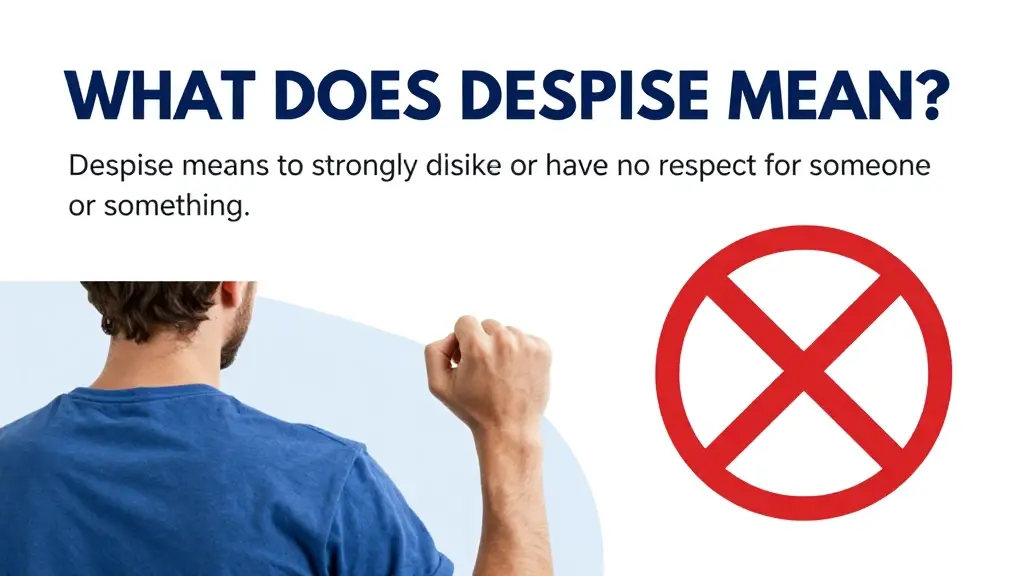
Despise means to strongly dislike or hate someone or something. It can also mean to have very little respect for someone or something. In simple words, if you despise something, you feel a very strong negative feeling toward it. For example, “She despises cruelty” means she strongly hates or dislikes cruelty.
Despise Meaning at a Glance
| Term | Meaning |
| Despise | To strongly dislike or hate |
| Part of speech | Verb |
| Pronunciation | dih-SPYZE |
| Main use | Expressing strong dislike |
| Tone | Strongly negative |
| Simple meaning | Hate or strongly dislike |
| Example | “I despise dishonesty.” |
What Does Despise Mean?
Despise means to strongly dislike, hate, or have very little respect for someone or something.
It expresses a much stronger feeling than ordinary dislike.
For example:
“He despises injustice.”
This means:
“He strongly hates or dislikes injustice.”
You can use despise for people:
“She despises her dishonest neighbor.”
You can also use it for actions or ideas:
“They despise cruelty.”
And you can use it for everyday things:
“I despise waking up early.”
The strength of the feeling depends on the context.
Despise Meaning in Simple Words
In simple English, despise means “to strongly dislike” or “to hate.”
You can understand it as:
- Strongly dislike
- Hate
- Have no respect for
- Feel strong dislike toward
- Look down on
- Strongly reject
For example:
“I despise cheating.”
Simply means:
“I strongly hate cheating.”
The word despise tells the reader that the feeling is much stronger than ordinary dislike.
Different Meanings and Uses of Despise
Although the basic meaning stays the same, despise can be used in different situations.
1. Despising a Person
Someone may despise another person because of their behavior or character.
Example:
“He despises people who lie to others.”
This means he has a very strong negative feeling toward dishonest people.
2. Despising an Action
Despise can describe a strong dislike of an action or behavior.
Example:
“She despises bullying.”
This means she strongly hates or disapproves of bullying.
3. Despising an Idea
You can despise an idea, belief, or practice.
Example:
“They despise the idea of unfair treatment.”
Here, despise means they strongly reject or dislike the idea.
4. Despising Something Ordinary
The word can also be used for everyday things.
Example:
“I despise cold coffee.”
This simply means the person strongly dislikes cold coffee.
5. Despising Someone’s Behavior
Sometimes people do not hate the person themselves but strongly disapprove of what the person does.
Example:
“I despise what he did.”
This means the speaker has a very strong negative reaction to his action.
What Does Despise Mean in a Relationship?
In relationship conversations, despise means having an extremely strong negative feeling toward someone.
For example:
“She despises him after what happened.”
This suggests that she strongly dislikes or hates him.
However, despise does not automatically mean that a relationship has ended or that two people are enemies. The sentence only tells us about the person’s strong negative feelings.
You may also hear:
“I despise being lied to.”
This focuses on the behavior rather than a specific person.
Despise Meaning in Texting
Despise is a normal English word rather than internet slang, so people may use it in texts just as they would in regular conversation.
For example:
“I despise Mondays.”
This means:
“I really hate Mondays.”
Another example:
“I despise people who waste food.”
Here, the person is expressing strong disapproval.
In casual texting, people may use simpler words such as hate, can’t stand, or really dislike, but despise is still perfectly understandable.
Despise Meaning on Social Media
On social media, people sometimes use despise in captions, comments, and posts to express strong dislike.
For example:
“I despise unnecessary drama.”
This means the person strongly dislikes unnecessary drama.
Another example:
“Things I despise: waiting in long lines.”
Here, the word is being used casually and may even have a humorous tone.
Because social media posts can be exaggerated, despise does not always mean literal hatred. Sometimes people use it simply to emphasize that they strongly dislike something.
Despise Pronunciation
Despise is pronounced:
dih-SPYZE
It has two syllables, with the stress on the second syllable.
The ending sounds like “size.”
Example:
“I despise dishonesty.”
Pronunciation:
dih-SPYZE
Origin of the Word Despise
The word despise comes from Old French despire, which came from Latin despicere, meaning “to look down on” or “to look down upon.”
The Latin word was formed from elements meaning “down” and “look.”
Over time, the meaning developed into the modern English sense of having a strong dislike or lack of respect for someone or something.
This origin helps explain why despise can carry both ideas of strong dislike and low respect.
How to Use Despise in a Sentence
Here are some natural examples:
- “I despise dishonesty.”
- “She despises people who break promises.”
- “He despises being treated unfairly.”
- “They despise cruelty toward animals.”
- “I despise waiting in long lines.”
- “She despises unnecessary arguments.”
- “He despises cheating in school.”
- “Many people despise unfair treatment.”
- “I absolutely despise wasting time.”
- “She despises the way he speaks to people.”
Despise Conversation Examples
Conversation 1: Everyday Use
Alex: “Do you like waking up early?”
Sam: “No, I despise it!”
Alex: “Same here. I prefer sleeping late.”
Here, despise means strongly dislike.
Conversation 2: Behavior
Alex: “Why does she avoid him?”
Sam: “She despises the way he treats other people.”
Alex: “That makes sense.”
Here, the strong negative feeling is connected to his behavior.
Synonyms for Despise
Several English words have meanings similar to despise:
1. Hate
To have an extremely strong dislike.
2. Detest
To strongly dislike something or someone.
3. Loathe
To strongly hate or dislike.
4. Dislike
To not like something or someone. This is usually weaker than despise.
5. Abhor
To strongly hate or consider something extremely bad.
6. Disdain
To feel that someone or something is beneath your respect or consideration.
7. Scorn
To treat someone or something with strong disrespect or contempt.
The best simple synonym for despise is usually hate or strongly dislike.
Despise vs. Hate
Despise and hate are very similar, but they can carry slightly different feelings.
Hate is a broad word for a very strong negative feeling.
Despise can suggest both strong dislike and a lack of respect.
For example:
“I hate rainy weather.”
This simply expresses strong dislike.
“I despise dishonesty.”
This can suggest not only strong dislike but also strong disapproval of dishonest behavior.
Both words are strong, but despise can sound more formal or literary.
Despise vs. Dislike
The biggest difference is strength.
Dislike means you do not like something.
Despise means you strongly dislike or hate something.
For example:
“I dislike spicy food.”
This means spicy food is not enjoyable to you.
“I despise cruelty.”
This expresses a much stronger feeling.
So, despise is much stronger than dislike.
Despise vs. Disdain
These words are close but not exactly the same.
Despise usually means to strongly dislike or hate.
Disdain often means to feel that someone or something is beneath your respect or attention.
For example:
“She despises dishonesty.”
She strongly dislikes it.
“He looked at the suggestion with disdain.”
He considered the suggestion unworthy or beneath consideration.
Is Despise an Offensive Word?
Despise is not a swear word or offensive term. However, it is a strong word because it expresses intense dislike or lack of respect.
Calling someone a person you despise can sound harsh.
In formal writing, the word can be completely appropriate when the context calls for a strong expression.
For example:
“The character despises corruption.”
This is a normal use of the word.
If you want a softer expression, you can use:
- “Dislike”
- “Strongly disagree with”
- “Do not approve of”
- “Do not like”
Common Confusions About Despise
One common mistake is using despise as if it simply means “do not like.”
While this is technically related to the meaning, despise is much stronger.
Another confusion is between despise and disdain. Both can involve negative feelings and lack of respect, but despise focuses more directly on strong dislike or hatred.
It is also useful to remember that despise is a verb.
Correct:
“I despise dishonesty.”
Incorrect:
“I am despise dishonesty.”
You can use despise directly with a person, thing, action, or idea.
FAQs
1. What does despise mean in simple words?
Despise means to strongly dislike or hate someone or something. It can also suggest having very little respect for them.
2. Is despise stronger than dislike?
Yes. Despise is much stronger than dislike. It usually expresses a deep or intense negative feeling.
3. Is despise the same as hate?
Despise and hate are very similar. Despise can also suggest strong disapproval or a lack of respect, while hate is a broader term.
4. What is a synonym for despise?
Common synonyms include hate, detest, loathe, abhor, disdain, and strongly dislike.
5. What does “I despise you” mean?
“I despise you” means “I strongly dislike or hate you.” It is a very strong negative statement about another person.
6. What does despise mean in a relationship?
In a relationship context, despise means having a very strong negative feeling toward someone. It can suggest intense dislike, hatred, or lack of respect.
7. How do you pronounce despise?
Despise is pronounced “dih-SPYZE.” It has two syllables, with the stress on the second syllable.
8. Is despise a bad word?
No. Despise is not a swear word. However, it is a strong word that expresses intense dislike or disapproval.
9. What is the opposite of despise?
Depending on the context, opposites include love, admire, respect, appreciate, and like.
10. Can you despise something without hating it?
Yes. Despise usually means extremely strong dislike, but people sometimes use it to express strong disapproval rather than literal hatred.
Conclusion:
Despise means to strongly dislike, hate, or have very little respect for someone or something.
It is much stronger than the word “dislike” and can describe feelings toward people, actions, ideas, habits, or situations.
The word is not offensive or a swear word, but it can sound harsh when directed at a person.
Common synonyms include hate, detest, loathe, and abhor.
If you want a softer expression, words such as “dislike” or “do not approve of” may be better choices.

Zachary Wilson is an American language writer who specializes in word meanings, online slang, abbreviations, and practical English usage for modern audiences.