

What does doula mean? A doula is a trained professional who provides emotional, physical, and informational support to a person during pregnancy, childbirth, and the period after birth.
A doula does not replace a doctor or midwife. Instead, a doula offers continuous support, comfort, practical help, and guidance during an important life event.
For example, a birth doula may help a person with breathing, movement, relaxation, and comfort during labor.
The word doula is most often used for people who support pregnant people and new parents, but doulas can have different specialties.
A birth doula focuses on pregnancy, labor, and birth, while a postpartum doula provides support after the baby is born.
Some doulas also support families after pregnancy loss or during other major reproductive experiences.
The role is becoming more familiar in everyday English, especially in discussions about pregnancy, birth plans, postpartum care, and family support.
Understanding what a doula does can help explain why someone might choose to have one.
Quick Answer
A doula is a trained professional who provides emotional, physical, and informational support during pregnancy, childbirth, or the postpartum period. A doula is not usually a medical provider and does not replace a doctor or midwife. Instead, they help with comfort, preparation, communication, and practical support.
Quick Meaning Table
| Term | Main meaning | Full form, if relevant | Pronunciation | Usage | Example |
| Doula | A trained person who provides support around pregnancy, birth, or after birth | Not an abbreviation | DOO-luh | Pregnancy, childbirth, postpartum care | “She hired a doula to support her during labor.” |
What Does Doula Mean?
A doula is a person who provides non-medical support to someone during pregnancy, labor, childbirth, or the period after birth.
A doula may provide:
- Emotional support
- Physical comfort
- Information and education
- Help with relaxation
- Help communicating preferences
- Practical support for the family
For example, during labor, a birth doula might suggest different positions, provide massage, encourage breathing techniques, or offer reassurance.
A doula does not normally diagnose medical problems, prescribe medicine, or perform medical procedures. Those responsibilities belong to qualified medical professionals such as doctors, nurses, and midwives.
The American College of Obstetricians and Gynecologists describes continuous labor support as a form of support that can include emotional support, physical comfort, and communication assistance. (acog.org)
Doula Meaning in Simple Words
In simple English:
A doula is someone who helps and supports a person before, during, or after childbirth.
Think of a doula as an extra source of support and guidance, rather than a medical professional.
For example:
“My doula helped me stay calm during labor.”
This means the doula provided emotional and practical support during childbirth.
A doula can also help a new parent after birth.
For example:
“The postpartum doula helped us adjust to life with the baby.”
Different Types of Doulas
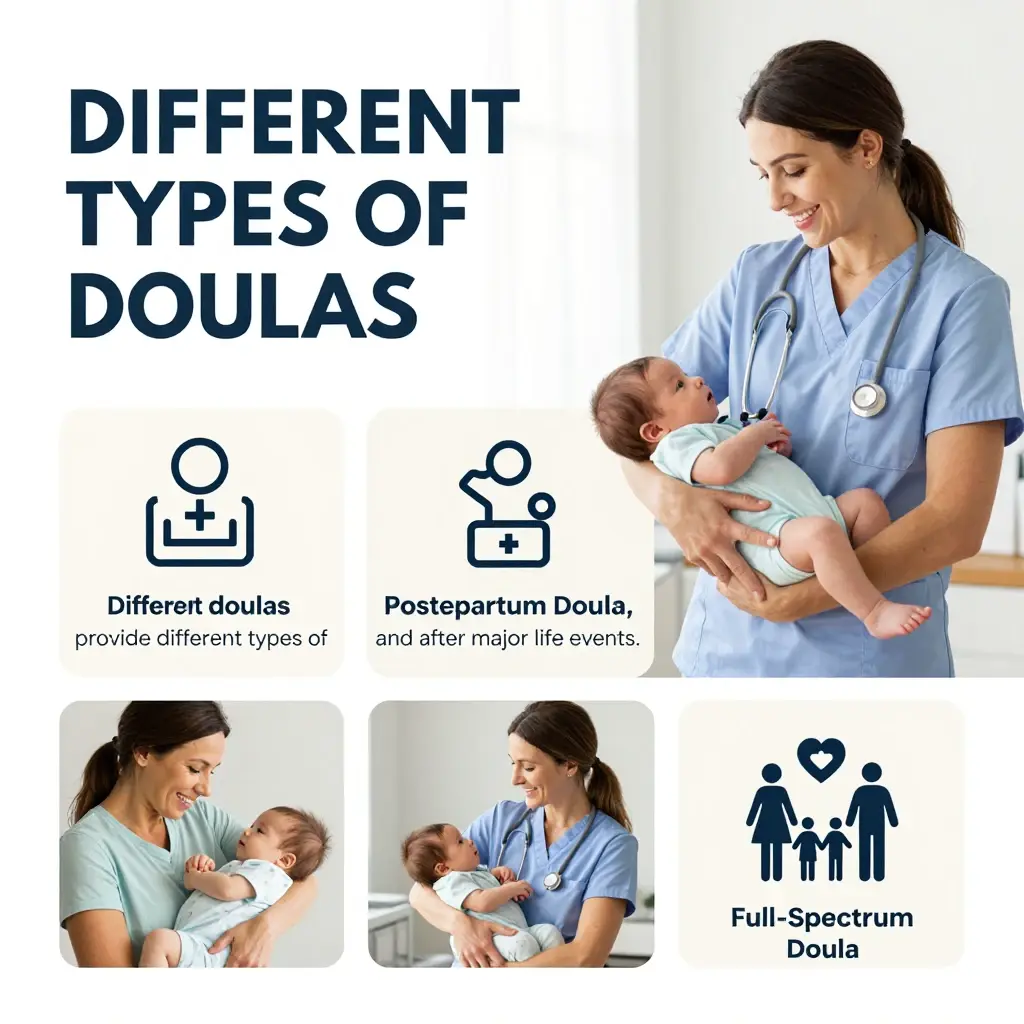
The word doula can describe different kinds of support professionals.
Birth Doula
A birth doula supports a person during pregnancy and labor and may remain with them through childbirth.
Support may include:
- Comfort measures
- Breathing and relaxation
- Position changes
- Emotional encouragement
- Help communicating with the birth team
A birth doula does not take the place of medical staff.
Postpartum Doula
A postpartum doula supports a family after the baby is born.
They may help with:
- New-parent adjustment
- Infant care education
- Feeding support
- Household organization
- Rest and recovery
- Emotional support
The exact services vary between doulas.
Bereavement or Loss Doula
Some doulas specialize in supporting people experiencing pregnancy loss, stillbirth, or other reproductive loss.
This is a sensitive area, and the services offered can vary significantly.
Full-Spectrum Doula
Some doulas describe themselves as full-spectrum doulas, meaning they offer support across a broader range of reproductive experiences. This can include pregnancy, birth, postpartum care, abortion, adoption, and pregnancy loss, depending on the individual doula’s training and services.
What Does a Doula Do?
A doula’s exact role depends on their specialty and agreement with the client.
A birth doula may:
- Meet with the family before birth
- Discuss birth preferences
- Provide emotional reassurance
- Suggest comfort techniques
- Offer massage or physical comfort
- Help with breathing and relaxation
- Support a partner or family member
- Help the client communicate their preferences
A postpartum doula may:
- Help new parents adjust to life with a baby
- Provide practical household support
- Offer information about newborn care
- Support feeding choices
- Encourage rest and recovery
- Provide emotional support
Doulas can provide valuable support, but they should not be confused with medical professionals.
Doula vs. Midwife
A doula and a midwife have different roles.
A midwife is a trained healthcare professional who provides maternity care within their scope of practice.
A doula provides non-medical support.
For example:
Midwife: Provides clinical care and monitors the health of the pregnant person and baby.
Doula: Provides emotional support, comfort, information, and continuous personal support.
A person can choose to have both a midwife and a doula.
The American College of Obstetricians and Gynecologists notes that continuous one-to-one support during labor can be provided by people such as doulas, nurses, or other support personnel. (acog.org)
Doula vs. Doctor
A doctor provides medical care and treatment.
A doula provides non-medical support.
For example, if a medical complication occurs during labor, a doula does not diagnose or treat it. The medical team handles the clinical situation.
The doula’s role is to continue offering appropriate emotional and practical support.
How to Pronounce Doula
Doula is usually pronounced:
DOO-luh
You can break it down as:
DOO + luh
The word sounds similar to:
“doo-luh.”
Example:
“She works as a birth doula.”
Origin of Doula
The modern use of doula comes from the Greek word doulē, traditionally translated as “female slave” or “female servant.”
The modern birth-support meaning developed in the 20th century, particularly through work associated with researchers and birth-support advocates who studied the effects of continuous support during labor.
The word’s historical meaning and its modern professional use are therefore quite different.
Merriam-Webster identifies the Greek origin of doula and defines its modern meaning as a person who provides support to women before, during, and after childbirth. (merriam-webster.com)
How to Use Doula in a Sentence
Here are 10 natural examples:
- “She hired a doula to support her during labor.”
- “Our doula helped us prepare for the birth.”
- “The birth doula provided emotional support throughout labor.”
- “We met with our doula several weeks before the baby was due.”
- “Her postpartum doula helped the family adjust after the birth.”
- “The doula showed us different comfort techniques.”
- “My partner and I decided to work with a doula.”
- “The doula supported her during a long labor.”
- “They asked their doula about different birth options.”
- “A doula can provide continuous non-medical support.”
Conversation Examples
Conversation 1: Choosing a Doula
Emma: Are you thinking about hiring a doula?
Sarah: Yes. I want someone who can give me extra support during labor.
Emma: Is a doula a medical professional?
Sarah: Not usually. The doula provides support and comfort, while the medical team handles medical care.
Conversation 2: Postpartum Support
Mike: Who is helping you now that the baby is home?
Lisa: We have a postpartum doula.
Mike: What does she help with?
Lisa: She helps us adjust to having a newborn and gives us practical support.
Synonyms and Similar Words
There is no perfect synonym for doula, because it describes a specific support role.
Birth Support Person
This is a general phrase for someone who supports a person during childbirth.
Labor Support Professional
This describes someone who provides support during labor, but it is less specific than doula.
Midwife
A midwife can provide pregnancy and birth care, but a midwife is a healthcare professional, while a doula’s role is generally non-medical.
Birth Coach
Some people informally use “birth coach” for a person who provides childbirth support. However, it is not necessarily the same as a doula, and the training and role can vary.
Caregiver
A caregiver provides help and support, but this is a much broader term and does not specifically describe a birth or postpartum doula.
Common Confusions
Doula vs. Midwife
This is one of the most common confusions.
A doula provides non-medical support.
A midwife provides healthcare within their professional scope.
They can work alongside each other.
Doula vs. Nurse
A nurse is a healthcare professional who provides medical or clinical care according to their training and role.
A doula’s main role is personal, emotional, informational, and physical support rather than clinical care.
Doula vs. Birth Coach
The terms can overlap in casual use, but doula is the more established term for a person providing continuous non-medical support around childbirth.
Doula vs. Babysitter
A doula is not simply a babysitter.
A postpartum doula may help parents with newborn-related tasks and adjustment, but their role is broader than simply watching a baby.
The exact responsibilities should always be agreed upon before hiring a doula.
Is Doula a Medical Term?
Doula is commonly used in healthcare and childbirth discussions, but a doula is not necessarily a medical professional.
The term describes a type of support role.
A person’s training, certification, and scope of work can vary. If someone is considering hiring a doula, it is useful to ask about their training, experience, services, availability, and fees.
FAQs
1. What does doula mean in simple terms?
A doula is a trained support person who helps someone during pregnancy, childbirth, or after birth. A doula provides emotional, physical, and informational support but generally does not provide medical care. Their role is to help the person feel informed, supported, and comfortable.
2. What does a doula do?
A doula provides non-medical support. Depending on their specialty, they may offer emotional reassurance, comfort techniques, information, help with relaxation, and practical support. A birth doula may support someone during labor, while a postpartum doula helps a family adjust after the baby is born.
3. Is a doula a doctor or nurse?
Usually, no. A doula’s role is generally non-medical. Doctors and nurses provide healthcare and clinical treatment. A doula provides personal support and comfort. A person may choose to have a doula while also receiving care from doctors, nurses, or midwives.
4. What is the difference between a doula and a midwife?
A midwife is a healthcare professional who provides maternity care within their scope of practice. A doula provides non-medical emotional, physical, and informational support. A person can have both because their roles are different and can complement each other.
5. What is a birth doula?
A birth doula is a trained professional who supports someone before and during labor and childbirth. They may provide comfort measures, encouragement, information, and help communicating preferences. They do not replace the medical team or provide medical treatment.
6. What is a postpartum doula?
A postpartum doula supports a parent and family after the baby is born. Depending on their training and services, they may provide practical help, newborn-care information, feeding support, emotional support, and assistance with the transition to life with a new baby.
7. How much does a doula cost?
Doula fees vary widely depending on location, experience, services, and the type of support provided. Some doulas charge a flat fee, while others offer different packages. Anyone considering a doula should ask for a clear explanation of what is included in the fee before hiring them.
8. How do you pronounce doula?
Doula is usually pronounced “DOO-luh.” The first syllable sounds like “doo,” followed by a short “luh.” The word comes from Greek and is now commonly used in English to describe a professional who provides support around childbirth and the postpartum period.
9. Can a doula deliver a baby?
A doula’s normal role is not to deliver babies or provide medical treatment. A doula provides non-medical support. The person responsible for clinical care and delivery depends on the birth setting and the healthcare professionals involved, such as a doctor or qualified midwife.
10. Why do people hire a doula?
People may hire a doula because they want continuous personal support, comfort, information, and encouragement during pregnancy, labor, or the postpartum period. A doula can also provide support to a partner or family member. The specific benefits and services vary between individuals and doulas.
Conclusion:
A doula is a trained professional who provides emotional, physical, and informational support during pregnancy, childbirth, or after birth.
A doula is generally not a medical provider and does not replace a doctor, nurse, or midwife.
Instead, the doula offers personal support, comfort, education, and practical help.
Birth doulas focus on labor and delivery, while postpartum doulas support families after the baby arrives.
If you see the word doula, think of a trained person whose main role is to support and guide someone through an important reproductive experience.

Brandon Lewis researches modern vocabulary and semantic trends to create informative, reader-focused language guides.