
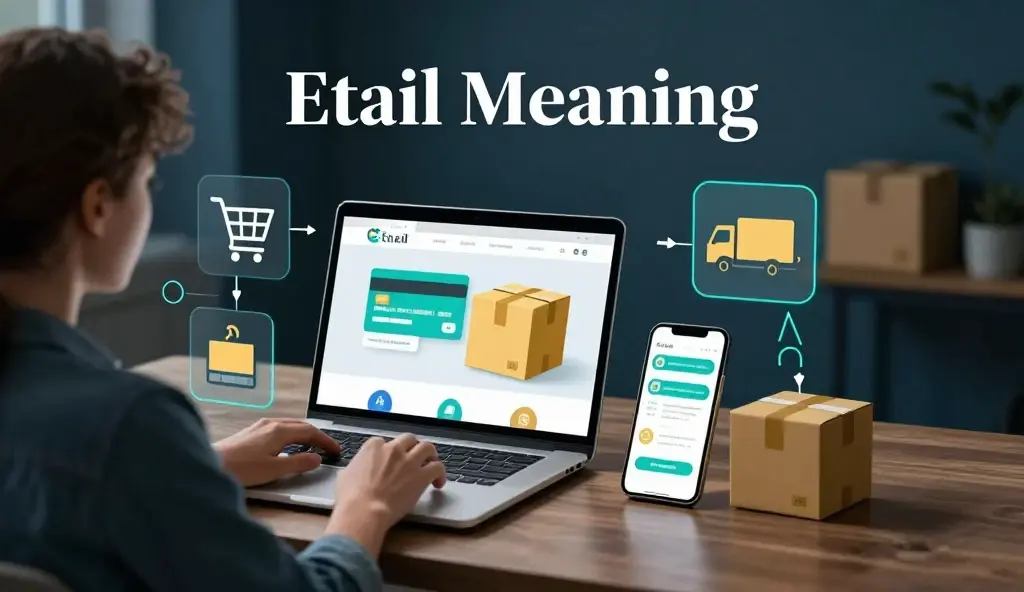
E-tail means electronic retailing, or the buying and selling of products and services through the internet.
The word is formed from “electronic” + “retail.” You may see e-tail in discussions about online shopping, e-commerce, digital stores, and internet businesses.
For example, an online clothing store that sells products directly to customers is an e-tail business.
The word is closely related to e-commerce, although e-tail focuses specifically on retail sales conducted electronically, especially online.
You may also see the spelling etail without a hyphen.
In everyday conversation, however, people are much more likely to say online retail, online shopping, or e-commerce. Understanding the term is useful when reading business, marketing, technology, and retail content.
Quick Answer
E-tail means electronic retailing—the sale of products or services to customers through electronic channels, especially the internet.
An online clothing shop, electronics website, or internet-based grocery store can be considered an e-tail business.
The term comes from electronic + retail.
Quick Meaning Table
| Term | Main meaning | Full form, if relevant | Pronunciation | Usage | Example |
| E-tail | Electronic retailing | Electronic retailing | EE-tail | Business, shopping, marketing | “E-tail sales continue to grow.” |
What Does E-tail Mean?
E-tail means electronic retailing. It describes the process of selling products or services to consumers through electronic channels, particularly websites and online stores.
For example:
“The company has expanded its e-tail business.”
This means the company has expanded its online retail sales.
An e-tail business might sell:
- Clothing
- Electronics
- Books
- Furniture
- Food
- Beauty products
- Home goods
- Digital products
The main idea is simple: retailing happens electronically rather than primarily through a physical store.
E-tail Meaning in Simple Words
In simple English, e-tail means selling things online.
Think of it this way:
Retail = selling directly to customers
E-tail = selling directly to customers online
For example, if a clothing company sells shirts through its website, that online sales activity is e-tail.
The term is often used in business and marketing rather than everyday conversation.
Different Meanings of E-tail
E-tail generally has one main meaning: electronic retailing. However, it can describe different types of online retail activity.
1. Online Retail
A company can sell products directly to customers through its website.
“The brand’s e-tail channel is growing rapidly.”
This means its online retail channel is growing.
2. Internet-Based Shopping
E-tail can also refer more broadly to shopping through online stores.
“Consumers have become more comfortable with e-tail.”
This means consumers are increasingly comfortable buying products online.
3. E-tail Business
An e-tail business is a retailer that sells products electronically, usually through an online store.
“The company started as a small e-tail business.”
E-tail Full Form
The e-tail full form is generally “electronic retail” or “electronic retailing.”
The word is a combination of:
E = electronic
Tail = retail
It follows the same naming pattern as e-commerce, where “e” represents electronic activity.
E-tail Meaning in Texting
E-tail is not normally texting slang.
If you see “e-tail” in a text message, business chat, or online discussion, it will usually have its standard business meaning: electronic retailing.
For example:
“She works in e-tail.”
This means:
“She works in online/electronic retail.”
Unlike abbreviations such as FS or SMH, e-tail is generally a business term rather than casual internet slang.
E-tail Meaning on Social Media
On social media, e-tail usually has the same meaning as standard business English: online retailing.
Marketing professionals, retailers, and business accounts may use the term when discussing:
- Online stores
- Digital sales
- Consumer shopping
- Retail websites
- Online marketplaces
- E-commerce strategies
For example:
“Brands are investing more in e-tail.”
This means brands are investing more in their online retail operations.
There is no common special TikTok, Instagram, Snapchat, or Reddit definition that changes the standard meaning of e-tail.
How to Pronounce E-tail
E-tail is pronounced:
EE-tail
The first part sounds like the letter “E,” followed by “tail.”
etail (/ˈiː.teɪl/)
You may also see it written as e-tail with a hyphen.
Origin of E-tail
E-tail was formed by combining electronic with retail, following the naming pattern used by terms such as e-mail and e-commerce.
The term developed alongside the growth of internet-based shopping and online retail businesses. As companies began selling products through websites, businesses and analysts needed terminology to describe this emerging form of retail.
Today, online retail, e-commerce, and e-tail are all used to discuss internet-based commerce, although e-tail specifically emphasizes the retail side.
How to Use E-tail in a Sentence
Here are 10 natural examples:
- “The company is expanding its e-tail business.”
- “E-tail has changed how consumers shop.”
- “The brand sells through both physical stores and e-tail channels.”
- “She works in e-tail marketing.”
- “The retailer invested heavily in its e-tail strategy.”
- “E-tail allows customers to shop from home.”
- “The company wants to increase its e-tail sales.”
- “Online advertising is important for successful e-tail businesses.”
- “The brand has a strong presence in e-tail.”
- “E-tail and traditional retail can work together.”
Conversation Examples
Conversation 1: Business
Alex: “Where does the company sell its products?”
Mia: “It has physical stores, but most of its e-tail sales come through its website.”
Alex: “So customers can order everything online?”
Mia: “Exactly.”
Conversation 2: Marketing
Sam: “What kind of marketing do you specialize in?”
Lena: “Mostly e-tail marketing for online retailers.”
Sam: “That makes sense. More brands are selling directly online now.”
Synonyms and Similar Words
Online Retail
A simple and widely understood term for selling products through the internet.
“The company is expanding its online retail business.”
This is often the easiest alternative to e-tail.
E-commerce
A broader term covering buying and selling through electronic networks, especially the internet.
E-commerce can include retail as well as other types of commercial transactions.
Internet Retail
Another term for retail activity conducted online.
Online Shopping
Usually refers to the customer’s activity of purchasing products online rather than the business activity itself.
Digital Commerce
A broader business term that can include online sales and other digitally enabled commercial activities.
Common Confusions
E-tail vs. E-commerce
These terms are closely related but are not always identical.
E-tail specifically focuses on retailing products or services electronically.
E-commerce is broader and can cover many kinds of electronic commercial transactions.
For example:
“The company is developing its e-tail strategy.”
focuses on its online retail business.
E-tail vs. Retail
Retail includes selling products directly to consumers through physical stores, websites, apps, and other channels.
E-tail specifically emphasizes electronic or online retailing.
E-tail vs. Online Shopping
Online shopping usually describes what consumers do.
E-tail usually describes the retail business or sales channel.
For example:
“I enjoy online shopping.”
describes a consumer activity.
“The company is investing in e-tail.”
describes a business strategy.
E-tail vs. Etail
Both e-tail and etail may be seen in writing. The hyphenated form e-tail makes the word’s construction clearer, while etail is also used as a closed form.
Is E-tail a Formal Word?
E-tail is mainly a business and marketing term.
It can appear in:
- Business articles
- Marketing reports
- Retail discussions
- Technology publications
- Industry research
- Corporate communications
However, online retail is usually clearer for a general audience.
For example:
“The company is growing its online retail business.”
is easier for most readers to understand than:
“The company is expanding its e-tail operations.”
1. What does e-tail mean?
A: E-tail means electronic retailing, especially selling products or services to consumers through the internet. An online clothing store, electronics website, or internet-based grocery business can be described as an e-tail business.
2. What is the full form of e-tail?
A: The full form of e-tail is generally electronic retail or electronic retailing. The term combines “electronic” with “retail” and refers primarily to retail activity conducted through online or other electronic channels.
3. Is e-tail the same as e-commerce?
A: Not exactly. E-tail focuses on electronic retailing, while e-commerce is a broader term for commercial transactions conducted electronically. E-tail can therefore be considered one part of the wider e-commerce field.
4. What is an example of e-tail?
A: An online clothing store that allows customers to choose products, pay online, and have items delivered to their homes is an example of e-tail.
5. Is e-tail a type of online shopping?
A: Yes, e-tail is closely connected to online shopping. More specifically, e-tail describes the retail business or activity behind selling products electronically, while online shopping usually describes the consumer’s activity of buying products online.
6. What is an e-tail business?
A: An e-tail business is a retail business that sells products or services through electronic channels, particularly the internet. It may operate entirely online or combine an online store with physical retail locations.
7. How do you pronounce e-tail?
A: E-tail is pronounced “EE-tail.” The first part sounds like the letter E, followed by the word “tail.” It is commonly written with a hyphen as e-tail.
8. Is e-tail the same as online retail?
A: They are essentially used for the same general concept. Online retail is more common and easier for most people to understand, while e-tail is a shorter business term for electronic retailing.
9. What is the difference between e-tail and retail?
A: Retail is the broader activity of selling products directly to consumers. E-tail refers specifically to retail conducted through electronic channels, especially online stores. Therefore, an online clothing shop is e-tail, while a traditional clothing store is retail.
10. Is e-tail still commonly used?
A: Yes, the term is still understood and used, particularly in business, marketing, and retail discussions. However, e-commerce and online retail are generally more familiar terms to everyday consumers.
Conclusion:
The e-tail meaning is electronic retailing, or selling products and services to customers through electronic channels, especially the internet.
It is closely related to e-commerce but focuses more specifically on the retail side of online business.
An online clothing store, electronics shop, or internet-based grocery retailer can all be examples of e-tail.
The term is mainly used in business and marketing contexts, while online retail is often the simpler phrase for everyday readers. When you see “e-tail,” think “retail done electronically.”
