
Last Updated:
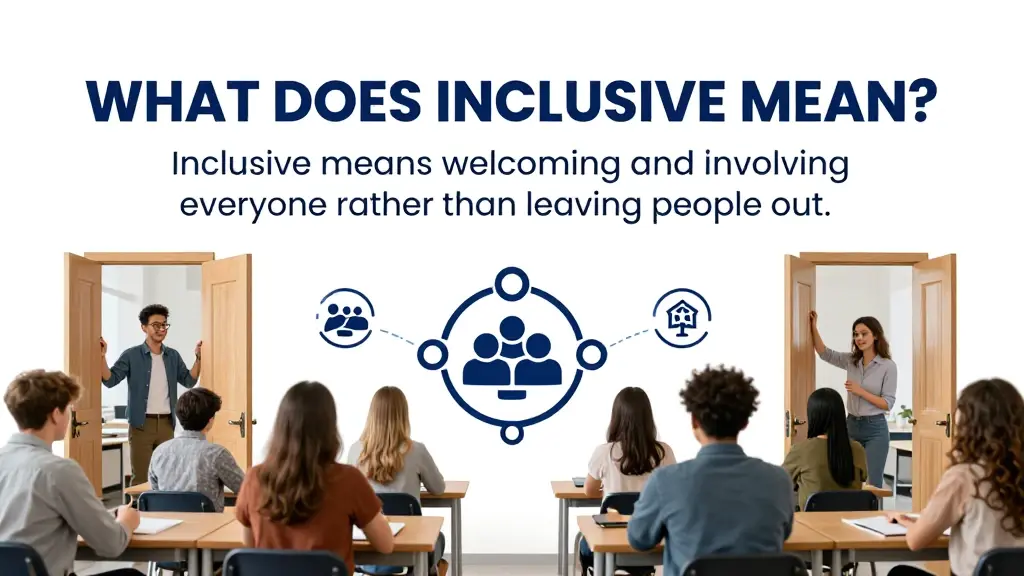
Inclusive means including everyone or everything that should be included.
It can describe a person, group, place, activity, price, or rule.
When we say someone is inclusive, we usually mean they welcome different kinds of people and treat them fairly and equally.
For example, an inclusive workplace makes people feel welcome, while an inclusive event is open to different groups of people.
The word can also have a more general meaning.
An inclusive price includes the things that might otherwise cost extra, such as taxes or fees.
When talking about dates or numbers, inclusive means the first and last numbers or dates are counted.
For example, “May 1 through May 5, inclusive” means May 1, 2, 3, 4, and 5.
In simple terms, inclusive means including people, things, or ideas rather than leaving them out.
Quick Answer: What Does Inclusive Mean?
Inclusive means including everyone or everything involved, without leaving people or things out.
When used for people, it often means being open, welcoming, and fair toward different types of people. When used for prices, it can mean that all required costs are already included. When used with dates or numbers, it means both ends of the range are counted.
Example:
“Our school has an inclusive environment where every student feels welcome.”
Quick Meaning Table
| Word | Meaning |
| Inclusive | Including everyone or everything |
| Part of speech | Adjective |
| Simple meaning | Open to all; nothing important is left out |
| People meaning | Welcoming and fair to different people |
| Price meaning | Includes the stated costs or extras |
| Date/number meaning | Includes both ends of a range |
| Opposite | Exclusive |
| Pronunciation | in-KLOO-siv |
| Common phrase | Inclusive of |
| Related word | Inclusion |
What Does Inclusive Mean?
Inclusive describes something that includes people, things, or ideas instead of excluding them.
For example:
- An inclusive classroom welcomes students with different needs and backgrounds.
- An inclusive team gives different people a chance to take part.
- An inclusive discussion allows different views to be heard.
- An inclusive price already contains certain costs.
- A date range that says “June 1 to June 10, inclusive” counts both June 1 and June 10.
The exact meaning depends on the sentence. However, the main idea is always connected to including rather than leaving out. Cambridge Dictionary lists these major uses, including inclusion of different people, complete prices, and both ends of a date or number range.
Inclusive Meaning in Simple Words
In very simple words, inclusive means “everyone is included” or “everything that belongs is included.”
Think about a group of friends planning a party.
If they invite only a few people and leave others out, the group is not very inclusive.
If they welcome everyone in the group and make sure everyone can take part, the group is inclusive.
The word can also mean that something is already included in a total.
For example:
“The ticket is $50, inclusive of taxes.”
This means the $50 price already includes the taxes.
So, inclusive can mean welcoming people or including things in a total.
Different Meanings of Inclusive
The word inclusive has several common meanings.
1. Inclusive of People
When describing people or groups, inclusive means welcoming different types of people and treating them fairly.
Example:
“The company wants to build a more inclusive workplace.”
This means the company wants employees from different backgrounds to feel welcome and treated fairly.
2. Inclusive of Everything
Inclusive can mean that something contains or covers everything expected.
Example:
“The package is inclusive of breakfast and transportation.”
This means breakfast and transportation are already part of the package.
3. Inclusive Price
An inclusive price contains certain costs that might otherwise be added separately.
Example:
“The hotel room costs $200, inclusive of taxes.”
The $200 price already includes the taxes.
4. Inclusive Dates or Numbers
When used after a range, inclusive means both the first and last dates or numbers count.
Example:
“The office will be closed from July 1 to July 5, inclusive.”
That means July 1, 2, 3, 4, and 5 are all included.
Is Inclusive an Adjective?
Yes. Inclusive is an adjective.
It is used to describe a person, group, environment, policy, price, range, or other thing.
Examples:
- an inclusive community
- an inclusive workplace
- an inclusive classroom
- an inclusive policy
- an inclusive price
- an inclusive environment
- an inclusive approach
The noun related to inclusive is inclusion.
For example:
“The school supports inclusion.”
Inclusion means the act or idea of including someone or something as part of a group or activity.
Inclusive Meaning in the Workplace
In the workplace, inclusive usually means creating an environment where different employees are welcomed, respected, and given opportunities to participate.
An inclusive workplace does not simply have different types of employees. It also tries to make sure people can contribute and feel that they belong.
Examples:
- “Our manager promotes an inclusive workplace.”
- “The company has an inclusive hiring policy.”
- “We want every employee to feel included.”
- “The meeting was designed to be inclusive.”
The term is often used with diversity, equity, and inclusion (DEI) in business and education. Cambridge describes DEI as an approach focused on equal rights and treatment, welcoming people, and reducing disadvantages connected to group membership.
Inclusive Meaning in Education
In education, inclusive often describes schools, classrooms, or teaching practices that allow different students to participate and learn.
For example:
“The school is committed to inclusive education.”
This can mean that students with different needs or circumstances are given ways to participate in the same learning environment.
An inclusive classroom may use different teaching methods, accessible materials, and flexible support so more students can take part.
The basic idea is simple: students should not be unnecessarily left out.
Inclusive Meaning in Social Situations
When someone is called inclusive, it usually means they make other people feel welcome.
For example:
“Sarah is very inclusive. She always makes sure everyone can join the conversation.”
Here, inclusive describes Sarah’s behavior.
An inclusive person may:
- welcome new people
- listen to different opinions
- avoid unfair exclusion
- invite others to participate
- respect differences
- make people feel comfortable
Being inclusive does not mean agreeing with everyone. It mainly means being willing to include and fairly consider people who might otherwise be left out.
Inclusive Meaning in Texting and Social Media
Inclusive does not have a special slang meaning in texting or social media. Its normal meaning is generally used.
Someone might write:
“I want the group to be more inclusive.”
This means they want more people to feel welcome and able to participate.
You may also see phrases such as:
- inclusive community
- inclusive language
- inclusive content
- inclusive space
- inclusive culture
- inclusive design
On social media, the word often appears in discussions about making communities, conversations, events, or content welcoming to different people.
Inclusive Meaning in Pricing
One of the most useful meanings of inclusive relates to money.
An inclusive price includes a particular cost or charge.
For example:
“The price is $100 inclusive of tax.”
This means the tax is already included in the $100.
Another example:
“The vacation package is $1,500 inclusive of meals.”
This means meals are already included in the stated price.
You may also see:
inclusive of tax
inclusive of fees
inclusive of meals
inclusive of breakfast
inclusive of shipping
Cambridge gives “inclusive of” as a common construction for something already included in a price or amount.
Inclusive Meaning for Dates and Numbers
When inclusive follows a range, it means both endpoints are included.
For example:
“The offer is valid from March 1 to March 10, inclusive.”
The offer is valid on:
- March 1
- March 2
- March 3
- March 4
- March 5
- March 6
- March 7
- March 8
- March 9
- March 10
The same idea works with numbers.
“Students aged 10 to 15, inclusive, may enter.”
This means ages 10, 11, 12, 13, 14, and 15 are included.
This use is common in instructions, rules, schedules, forms, and official writing.
How to Pronounce Inclusive
Inclusive is pronounced:
in-KLOO-siv
A common American English pronunciation is:
/ɪnˈkluː.sɪv/
Break it into three parts:
in + cloo + siv
The main stress is on “cloo.”
Example:
“The program is inclusive.”
Say it like:
“The program is in-KLOO-siv.”
Origin of the Word Inclusive
Inclusive comes from the word include, which relates to the idea of containing or bringing something into a group or whole.
The modern word has developed several connected uses. Today, dictionaries use inclusive for ideas such as including people, including costs, and counting both ends of a range.
Because the word has several established meanings, its exact meaning is best understood from the context in which it appears.
The related noun inclusion refers to the act or idea of including someone or something as part of a group, list, or activity.
Inclusive vs. Exclusive
Inclusive and exclusive are opposites in many common situations.
| Inclusive | Exclusive |
| Includes people or things | Leaves people or things out |
| Open to different people | Limited to certain people |
| Includes stated costs | May leave costs out |
| Counts both ends of a range | May not count one or both ends |
| Welcoming | Restrictive or limited |
Example:
Inclusive:
“Everyone is welcome to join.”
Exclusive:
“Membership is limited to invited guests.”
Another example:
Inclusive price:
“$100 inclusive of tax.”
Non-inclusive price:
“$100 plus tax.”
Inclusive vs. Inclusion
These words are related but are not the same part of speech.
Inclusive is an adjective.
“We want an inclusive workplace.”
Inclusion is a noun.
“We support inclusion in the workplace.”
Inclusive describes something that includes people or things.
Inclusion refers to the act or idea of including them.
Cambridge defines inclusion as the act of including someone or something as part of a group, list, or other whole.
Inclusive vs. Inclusivity
Inclusive is an adjective, while inclusivity is a noun.
Inclusive:
“The company has an inclusive culture.”
Inclusivity:
“The company values inclusivity.”
Inclusivity means the quality or practice of including different types of people, things, or ideas and treating them fairly.
A simple way to remember the difference:
- Inclusive = describes something
- Inclusivity = the quality or practice of being inclusive
Synonyms for Inclusive
The best synonym depends on the context.
When talking about people:
- welcoming
- open-minded
- tolerant
- accepting
- broad-minded
- fair
- open
When talking about amounts:
- including
- complete
- comprehensive
- all-inclusive
- total
Example:
“She created a welcoming and inclusive environment.”
Here, welcoming is a close synonym.
For prices:
“The fee is all-inclusive.”
Here, all-inclusive may be a better choice.
Cambridge lists words such as open-minded, tolerant, broad-minded, receptive, unbiased, and non-judgmental among related terms when inclusive means willing to consider different people or ideas.
Common Mistakes With Inclusive
Mistake 1: Thinking inclusive only means “everyone”
Inclusive can describe people, but it can also describe prices, amounts, dates, and numbers.
Correct:
“The price is inclusive of tax.”
Mistake 2: Confusing inclusive with inclusion
These words are related but have different grammatical roles.
Correct:
“The policy is inclusive.”
Correct:
“The policy supports inclusion.”
Mistake 3: Forgetting the last date
If a rule says:
“January 1 through January 5, inclusive”
January 5 is included.
Mistake 4: Assuming inclusive means agreement
Being inclusive does not mean agreeing with every idea. It generally means being willing to include or fairly consider people, ideas, or things.
Everyday Examples of Inclusive
Here are some natural examples:
- “The teacher created an inclusive classroom.”
- “Our event is open and inclusive.”
- “The company wants a more inclusive culture.”
- “The price is inclusive of breakfast.”
- “The fee is inclusive of all taxes.”
- “The program runs from June 1 to June 7, inclusive.”
- “We need an inclusive solution.”
- “She has an inclusive attitude.”
- “The club welcomes people from different backgrounds.”
- “The team worked hard to create an inclusive environment.”
Inclusive in a Sentence
Here are a few simple sentence examples:
“The new playground is designed to be inclusive.”
“The meeting should be inclusive and welcoming.”
“The hotel offers an inclusive package.”
“The price is inclusive of service fees.”
“The dates listed are inclusive.”
“We want to create a more inclusive community.”
“The teacher uses inclusive activities in the classroom.”
“The group took an inclusive approach to the discussion.”
Conversation Examples
Conversation 1
Alex: Is everyone invited to the meeting?
Jordan: Yes. We want it to be inclusive.
Alex: Great. That means everyone can share their ideas.
Jordan: Exactly.
Conversation 2
Customer: Does the $200 price include taxes?
Hotel Staff: Yes. The price is inclusive of taxes.
Customer: Great. So I won’t have to add the tax later?
Hotel Staff: Correct.
Is Inclusive a Positive Word?
Usually, yes.
When describing a person, workplace, community, classroom, or environment, inclusive is generally a positive word. It suggests that people are welcomed, respected, and given a chance to participate.
For example:
“She created an inclusive environment.”
This is normally praise.
However, like many words, its meaning depends on context. A person could also use the word sarcastically or critically.
Is Inclusive Offensive?
No, inclusive is not normally an offensive word.
It is generally a neutral or positive adjective. It is commonly used to describe welcoming environments, fair practices, broad participation, and prices or ranges that include specific items.
For example:
“The event is inclusive.”
There is nothing offensive about this sentence.
The meaning can change based on the surrounding context, but the word itself is not generally considered offensive.
What Is the Opposite of Inclusive?
The most common opposite of inclusive is exclusive.
Inclusive means something or someone is included.
Exclusive means something or someone is left out or limited to a particular group.
Example:
“The club is inclusive.”
This suggests the club welcomes different people.
“The club is exclusive.”
This suggests membership is limited or restricted.
The exact opposite depends on the context, but exclusive is the most common antonym.
FAQs
1. What does inclusive mean in simple words?
Inclusive means including people or things instead of leaving them out. When describing people, it often means welcoming and treating different people fairly. When describing a price, it can mean certain costs are already included.
2. What does inclusive mean in a sentence?
Inclusive can mean different things depending on context. For example, “She created an inclusive environment” means she created a welcoming environment. “The price is inclusive of tax” means tax is already included.
3. What does inclusive mean in price?
An inclusive price includes the costs mentioned or expected. For example, “$100 inclusive of tax” means the $100 price already includes tax. You do not normally add that tax separately.
4. What does inclusive mean for dates?
For dates, inclusive means both the first and last dates are counted. If something runs from May 1 to May 5, inclusive, then May 1 and May 5 are both included.
5. What does inclusive mean at work?
At work, inclusive usually means welcoming people with different backgrounds, experiences, or needs and treating them fairly. An inclusive workplace aims to give people opportunities to participate and feel respected.
6. Is inclusive a positive word?
Yes, inclusive is usually positive when it describes people or groups. It often suggests openness, fairness, welcome, and participation. It can also have a neutral meaning when describing prices, amounts, dates, or numbers.
7. What is the opposite of inclusive?
The most common opposite is exclusive. Inclusive means including people or things, while exclusive often means limiting access or leaving certain people or things out.
8. What is the difference between inclusive and inclusion?
Inclusive is an adjective that describes something. Inclusion is a noun referring to the act or idea of including someone or something. For example, “an inclusive school” and “support for inclusion.”
9. Is inclusive the same as accepting?
They can be similar, but they are not exactly the same. Accepting often focuses on respecting or allowing differences, while inclusive emphasizes actively including people or things and allowing them to participate.
10. What does all-inclusive mean?
All-inclusive means that everything specified or expected is included in one package, price, or arrangement. For example, an all-inclusive vacation may include accommodation, meals, and selected activities.
Conclusion:
The word inclusive generally means including people or things rather than leaving them out.
When describing people or groups, it often means welcoming different people and treating them fairly.
When describing prices, it means certain costs are already included.
When used with dates or numbers, it means both ends of the range are counted.
Remember the simple idea: inclusive means “included.” The exact meaning depends on the context, but the central idea is always about bringing something into the whole rather than leaving it outside.

Brandon Lewis researches modern vocabulary and semantic trends to create informative, reader-focused language guides.