

Have you ever heard someone say “time is money,” “the world is a stage,” or “her voice was music” and wondered how these statements make sense? These phrases are examples of metaphors, a powerful way people use language to express ideas creatively and emotionally.
A metaphor is a figure of speech that compares two different things by saying one thing is another, without using “like” or “as.”
Metaphors help explain complex ideas, create strong images, and add deeper meaning to writing, conversations, and art.
Quick Answer
A metaphor is a comparison between two unrelated things where one thing is described as another to show a shared quality or idea.
It is used to make language more meaningful, imaginative, and easier to understand.
What Does Metaphor Mean?
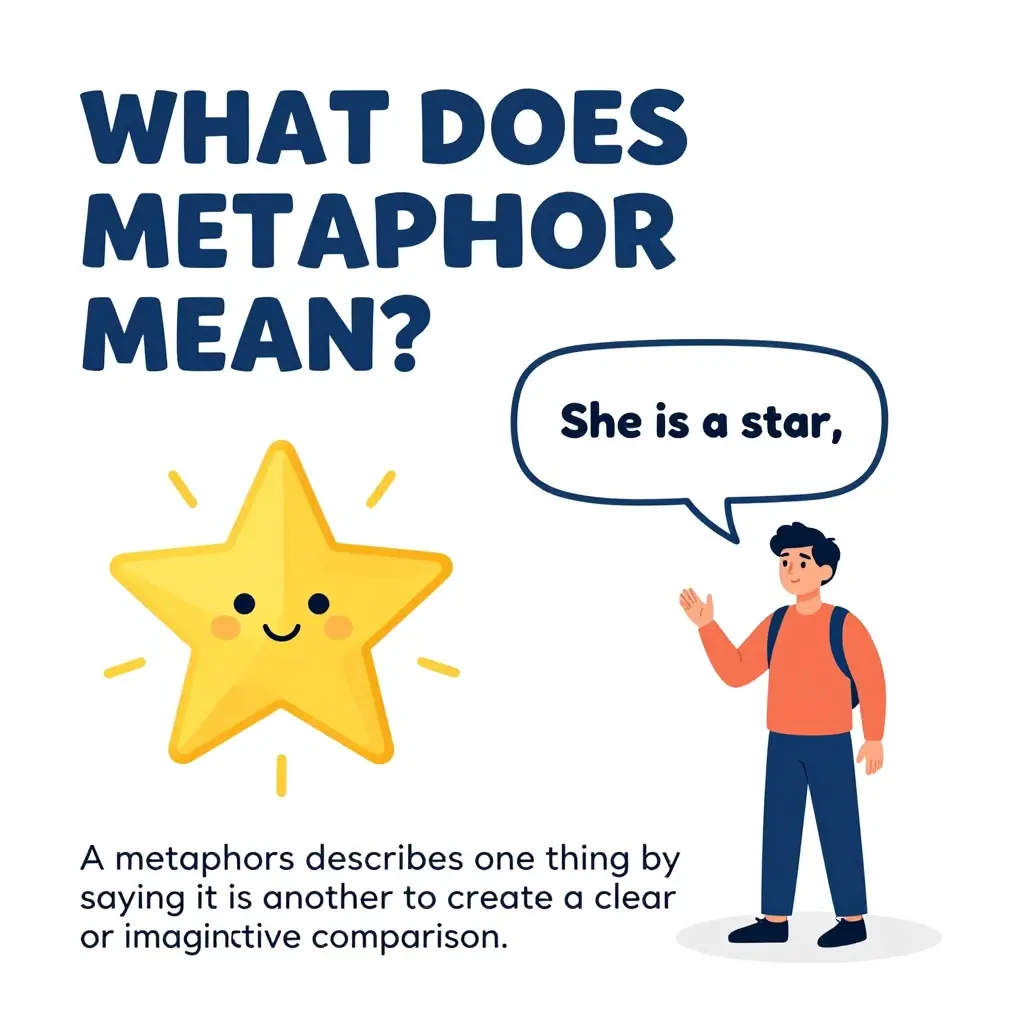
The word metaphor comes from the Greek word “metaphora,” meaning “to carry across” or “transfer.”
A metaphor transfers the qualities of one thing to another.
For example:
“Life is a journey.”
Life is not literally a road or trip, but the metaphor suggests that life includes:
- Different stages.
- Challenges.
- Decisions.
- Changes.
What Is the Difference Between a Metaphor and a Simile?
A common question is how metaphors differ from similes.
Metphor
A metaphor says something is something else.
Example:
“Her smile is sunshine.”
Meaning:
Her smile brings happiness and warmth.
Simile
A simile compares using “like” or “as.”
Example:
“Her smile is like sunshine.”
Both create comparisons, but the structure is different.
What Does Metaphor Mean in Writing?
In writing, metaphors help authors communicate emotions and ideas in a memorable way.
Writers use metaphors to:
- Create vivid images.
- Express feelings.
- Make stories more engaging.
- Explain difficult concepts.
Example:
“The classroom was a zoo.”
Meaning:
The classroom was noisy and chaotic.
What Does Metaphor Mean in Literature?
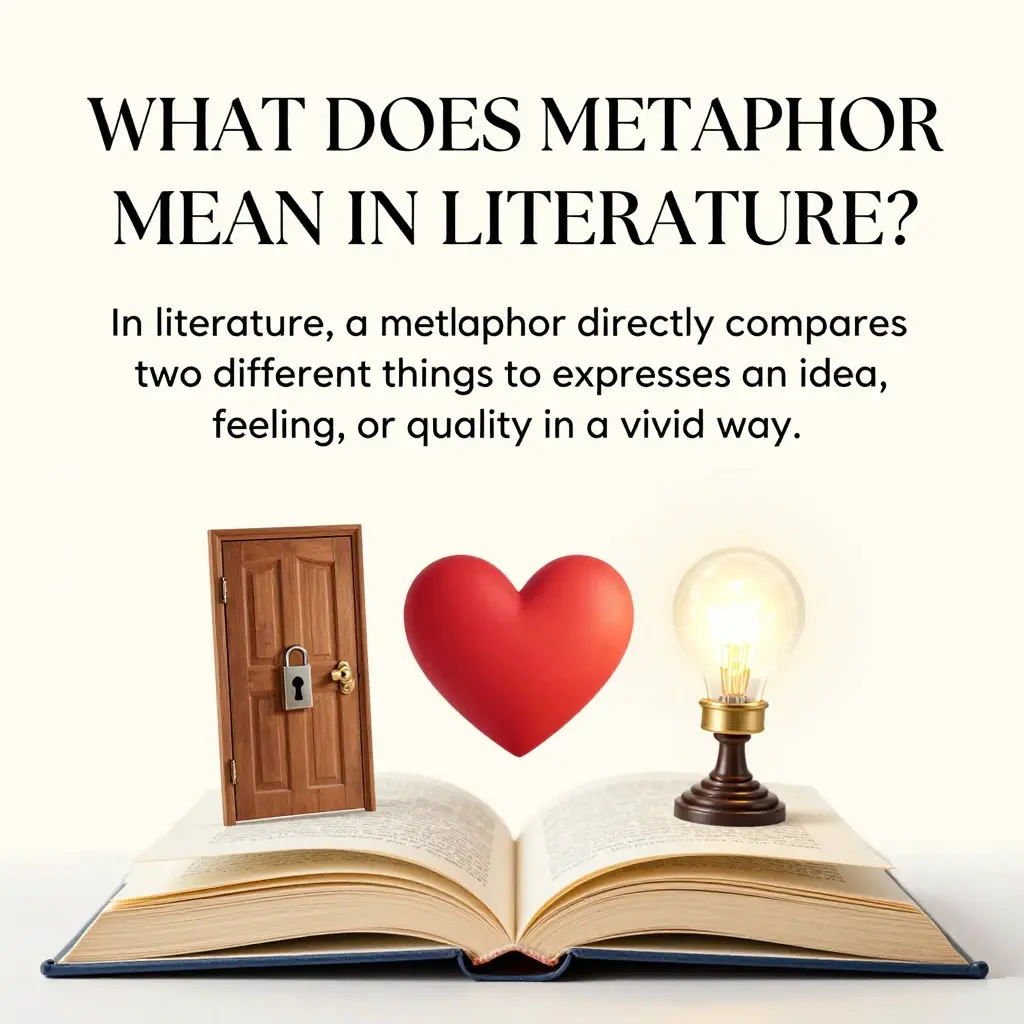
Metaphors are one of the most important tools in literature.
Authors use them to explore:
- Human emotions.
- Relationships.
- Society.
- Life experiences.
Examples:
“All the world’s a stage.”
This metaphor suggests that people play different roles throughout life.
“The heart is a lonely hunter.”
This metaphor describes emotional searching and longing.
What Does Metaphor Mean in Everyday Language?
People use metaphors every day without realizing it.
Common examples:
“I’m drowning in work.”
Meaning:
“I have too much work.”
“He has a heart of stone.”
Meaning:
“He seems emotionally cold.”
“She has a bright future.”
Meaning:
“She has many opportunities ahead.”
What Does Metaphor Mean in Love and Relationships?
Metaphors are often used to describe romantic feelings.
Examples:
“You are my rock.”
Meaning:
“You give me support and stability.”
“Our relationship is a garden.”
Meaning:
“A relationship needs care and attention to grow.”
“My heart is broken.”
Meaning:
“I feel deep emotional pain.”
What Does Metaphor Mean in Poetry?
Poetry uses metaphors to create deeper meanings.
A poet may use a simple image to represent a larger idea.
Example:
“Hope is a candle.”
Meaning:
Hope provides light during difficult times.
Metaphors allow readers to interpret feelings in personal ways.
What Does Metaphor Mean on Social Media?
On platforms like:
- TikTok
- X (Twitter)
people use metaphors in:
- Captions.
- Quotes.
- Memes.
- Videos.
Examples:
“I’m in my butterfly era.”
Meaning:
“I am changing, growing, or becoming a better version of myself.”
“This song is a time machine.”
Meaning:
“The song brings back memories.”
Does Metaphor Have a Spiritual Meaning?
Metaphors are often used in spiritual and religious discussions.
They help explain ideas that are difficult to describe literally.
Examples:
- “Light” as a metaphor for wisdom or goodness.
- “A path” as a metaphor for life choices.
- “A journey” as a metaphor for personal growth.
The meaning depends on the belief system and context.
Does Metaphor Have a Cultural Meaning?
Yes.
Different cultures use metaphors to express:
- Values.
- Traditions.
- Human experiences.
- Social ideas.
For example:
- A bridge often represents connection.
- A journey often represents personal growth.
- A storm often represents challenges.
Types of Metaphors
1. Simple Metaphor
A direct comparison between two things.
Example:
“The snow is a blanket.”
Meaning:
The snow covers the ground like a blanket.
2. Extended Metaphor
A metaphor that continues throughout a paragraph, story, or poem.
Example:
A writer comparing life to a journey throughout an entire chapter.
3. Implied Metaphor
A comparison that is suggested rather than directly stated.
Example:
“She flew through the competition.”
Meaning:
She performed extremely well.
4. Dead Metaphor
A metaphor so common that people no longer notice it.
Examples:
- “The leg of a table.”
- “The hands of a clock.”
Examples of Common Metaphors
| Metaphor | Meaning |
| Time is money | Time is valuable |
| The world is a stage | People play different roles in life |
| He has a heart of gold | He is kind |
| She is a shining star | She is talented |
| Knowledge is power | Learning creates strength |
Common Mistakes About Metaphors
Myth 1
Metaphors are always poetic.
False.
People use metaphors in normal conversations every day.
Myth 2
Metaphors are meant to be taken literally.
False.
They express ideas through comparison, not facts.
Myth 3
Metaphors and similes are the same.
False.
Similes use “like” or “as,” while metaphors make a direct comparison.
FAQs
Q1. What does metaphor really mean?
A: A metaphor is a figure of speech that compares two different things by saying one thing is another to create a deeper meaning.
Q2. Is a metaphor positive or negative?
A: A metaphor can be positive, negative, or neutral depending on the comparison being made.
Q3. Is metaphor romantic?
A: Not necessarily. Metaphors are often used in romantic expressions, but they are also common in everyday language, literature, and poetry.
Q4. How do you identify a metaphor?
A: Look for a phrase where something is described as something else without using “like” or “as.” For example, “Her eyes were stars.”
Q5. Why do writers use metaphors?
A: Writers use metaphors to make ideas clearer, stronger, more vivid, and emotionally powerful.
Q6. How do you pronounce metaphor?
A: It is commonly pronounced MET-uh-for.
Conclusion:
A metaphor is a creative comparison that describes one thing as another to express a deeper meaning.
Metaphors make language more powerful by helping people understand emotions, ideas, and experiences in a memorable way.
From everyday conversations to famous poems and stories, metaphors are everywhere.
Once you understand how they work, you can recognize the hidden meanings behind many expressions you hear and read.
