
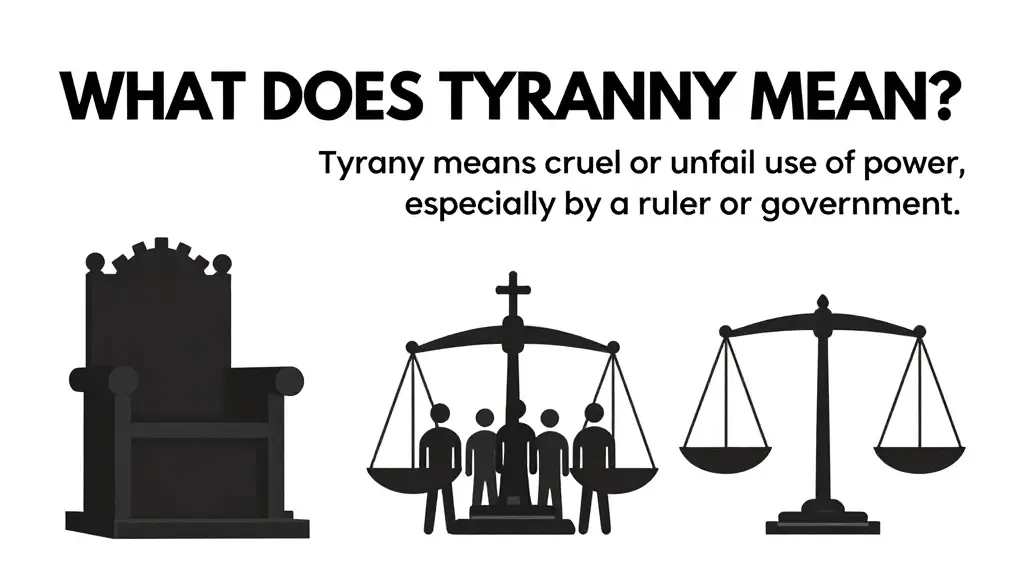
Tyranny means cruel, unfair, or oppressive use of power, especially by a ruler or government.
It describes a situation where someone in power controls people harshly and does not respect their rights or freedom.
The word is often used when authority is used in an unjust or abusive way.
You may see tyranny in history books, political discussions, literature, news articles, and everyday conversations.
It can describe the rule of a dictator, an oppressive government, or even a person who has too much control over others.
In a broader sense, the word can also describe any situation where someone uses power unfairly.
Quick Answer
Tyranny means cruel and unfair use of power or control. It often describes oppressive rule by a ruler or government that severely limits people’s freedom or rights. In simple words, tyranny is harsh control by someone who has power. For example, “The people suffered under tyranny” means they lived under cruel or oppressive rule.
Quick Meaning Table
| Term | Main Meaning | Part of Speech | Pronunciation | Usage | Example |
| Tyranny | Cruel or oppressive use of power | Noun | TIR-uh-nee | Politics, history, everyday English | “The people fought against tyranny.” |
What Does Tyranny Mean?
Tyranny means the unfair, cruel, or oppressive use of power.
The word is most often connected with political rule. A government or ruler may be described as tyrannical when they use power in a harsh way and do not allow people normal freedom or rights.
For example:
“The citizens lived under tyranny.”
This means the citizens lived under harsh and oppressive control.
Tyranny can also be used outside politics.
For example:
“The tyranny of an unfair boss made work difficult.”
Here, the word describes someone using authority oppressively or unreasonably.
Tyranny Meaning in Simple Words
In simple words, tyranny means using power in a cruel or unfair way to control other people.
Imagine a person has authority over a group. Instead of using that authority fairly, they make unreasonable rules, punish people unfairly, and refuse to give them freedom.
That kind of harsh control can be called tyranny.
Simple examples:
- Cruel rule = tyranny
- Unfair control = tyranny
- Oppressive power = tyranny
- Harsh government rule = tyranny
Different Meanings of Tyranny
Tyranny has a main meaning related to oppressive power, but it can be used in several contexts.
1. Oppressive Government Rule
Tyranny can describe a government or ruler that exercises power in a cruel or oppressive way.
Example:
“The people wanted freedom from tyranny.”
This means they wanted freedom from oppressive rule.
2. Cruel Use of Authority
The word can also describe someone using their authority unfairly.
Example:
“The manager’s tyranny made the workplace stressful.”
Here, tyranny refers to harsh or unreasonable control.
3. Excessive Control
In broader or figurative use, tyranny can describe something that seems to control people excessively.
Example:
“She complained about the tyranny of strict rules.”
This uses the word more broadly to describe oppressive restrictions.
Tyranny vs. Dictatorship
Tyranny and dictatorship are related, but they do not mean exactly the same thing.
A dictatorship is a form of government in which power is concentrated in one person or a small group, often without meaningful political competition or public control.
Tyranny focuses more on how power is used—especially when power is exercised cruelly, unfairly, or oppressively.
A dictatorship may be described as tyrannical if its rulers use their power in an oppressive way.
Tyranny vs. Oppression
These words are closely related.
Oppression means treating people unfairly or cruelly, especially by using power or authority.
Tyranny usually emphasizes harsh or oppressive control by someone in power.
For example:
“The people suffered oppression.”
This focuses on the unfair treatment.
“The people lived under tyranny.”
This emphasizes the oppressive system of rule or control.
Tyranny vs. Authoritarianism
Authoritarianism generally refers to a system or style of government with strong centralized authority and limited political freedoms.
Tyranny is a stronger and more negative term that emphasizes cruel, unjust, or oppressive use of power.
The words can overlap, but they should not automatically be treated as exact synonyms.
How to Pronounce Tyranny
Tyranny is commonly pronounced:
TIR-uh-nee
Easy pronunciation:
Tyranny = TIR-uh-nee
The first part sounds like “tir,” followed by “uh-nee.”
The adjective tyrannical is pronounced differently:
tih-RAN-ih-kul
Origin of Tyranny
The word tyranny comes from the Greek word tyrannia, meaning the rule or government of a tyrant.
The related word tyrant comes from the Greek tyrannos, referring to a ruler who held power without the traditional or lawful basis expected of a king.
Over time, tyranny developed the strong modern sense of cruel, oppressive, or unjust rule.
The word has been used for centuries in discussions of government, political power, history, and human freedom.
What Is a Tyrant?
A tyrant is a person who exercises power in a cruel, oppressive, or unjust way.
For example:
“The tyrant refused to listen to the people.”
The related words are:
- Tyrant — a person who rules oppressively
- Tyranny — oppressive or cruel rule
- Tyrannical — describing cruel or oppressive behavior
Example:
Tyrant: The ruler was a tyrant.
Tyranny: The people suffered under his tyranny.
Tyrannical: His rule was tyrannical.
How to Use Tyranny in a Sentence
Here are 10 natural examples:
- The people wanted to be free from tyranny.
- The novel tells the story of a country living under tyranny.
- The citizens protested against what they believed was tyranny.
- History contains many examples of people resisting tyranny.
- The king was accused of ruling with tyranny.
- The story describes the struggle between freedom and tyranny.
- The people hoped that the period of tyranny would eventually end.
- The writer warned about the dangers of unchecked power and tyranny.
- The community rejected the leader’s attempt to control everyone through tyranny.
- The book explores how ordinary people respond to tyranny.
Conversation Examples
Conversation 1
Ali: Why did the people rebel against the ruler?
Hamza: They believed they were living under tyranny and wanted greater freedom.
Conversation 2
Sara: What does tyranny mean?
Ayesha: It means cruel or unfair use of power, especially by a ruler or government.
Synonyms and Similar Words
Here are some words related to tyranny:
- Oppression — cruel or unfair treatment
- Despotism — government by a ruler with absolute power
- Dictatorship — government controlled by a dictator or small ruling group
- Tyrannical rule — oppressive or cruel rule
- Authoritarianism — strong centralized control with limited political freedom
- Despotism — harsh or absolute rule
- Domination — control over another person or group
- Abuse of power — using authority unfairly or improperly
These words can overlap, but they are not always exact substitutes. The best word depends on the context.
Common Confusions About Tyranny
Does tyranny always mean government?
No. Tyranny is most commonly associated with political rule, but it can also be used more broadly for oppressive or excessive control by someone with authority.
Is tyranny the same as dictatorship?
Not exactly. A dictatorship describes a type of political system, while tyranny emphasizes cruel, unjust, or oppressive use of power.
What is a tyrant?
A tyrant is someone who uses power in a cruel, oppressive, or unjust way.
What is the adjective form of tyranny?
The adjective is tyrannical, meaning cruel, oppressive, or characteristic of a tyrant.
Is tyranny always negative?
Yes. Tyranny has a strongly negative meaning because it refers to oppressive, cruel, or unjust use of power.
Is Tyranny Offensive?
Tyranny is not a swear word or inherently offensive term. It is a strong negative word used to describe oppressive or unjust use of power.
Because it is a serious term, it should be used carefully when describing real people, governments, or situations. In historical or political writing, the meaning depends on the specific evidence and context.
FAQs
1. What does tyranny mean?
Tyranny means cruel, unfair, or oppressive use of power, especially by a ruler or government.
2. What does tyranny mean in simple words?
In simple words, tyranny means harsh and unfair control by someone who has power.
3. What is an example of tyranny?
An example of tyranny is a ruler using extreme authority to control people while denying them basic freedoms and treating them unfairly.
4. What is a tyrant?
A tyrant is a person who uses power in a cruel, oppressive, or unjust way.
5. Is tyranny the same as dictatorship?
No. A dictatorship describes a type of government, while tyranny describes oppressive or cruel use of power. The two concepts can overlap.
6. What is the opposite of tyranny?
Depending on the context, possible opposites include freedom, liberty, justice, democracy, and fair rule.
7. How do you pronounce tyranny?
Tyranny is commonly pronounced “TIR-uh-nee.”
8. What is the adjective form of tyranny?
The adjective form is tyrannical, which means cruel, oppressive, or characteristic of a tyrant.
9. Is tyranny always negative?
Yes. Tyranny has a strongly negative meaning because it refers to cruel, oppressive, or unjust control.
10. What are some synonyms for tyranny?
Common related words include oppression, despotism, domination, dictatorship, and abuse of power, although their meanings are not always identical.
Conclusion:
Tyranny means cruel, unfair, or oppressive use of power.
It is most often used to describe harsh rule by a ruler or government, but it can also describe excessive control in other situations.
The related word tyrant refers to a person who exercises power in an oppressive way, while tyrannical describes behavior or rule that is cruel or oppressive.
Understanding the context is important because tyranny is a strong word that describes serious abuse or misuse of authority.

Brandon Lewis researches modern vocabulary and semantic trends to create informative, reader-focused language guides.