

Have you ever heard someone say, “That’s so ironic!” after something unexpected happened? The word ironic is commonly used in everyday conversations, movies, books, and social media.
However, many people confuse irony with coincidence or bad luck.
Understanding what ironic really means can help you recognize it in conversations, literature, and real-life situations.
Ironic describes a situation where the actual outcome is very different from, or even opposite to, what was expected.
It can also refer to words or actions that express one meaning while suggesting the opposite, often for humorous or dramatic effect.
Quick Answer
Ironic means something happens in a way that is opposite to what was expected or intended.
It can describe surprising situations, speech, or events that create contrast between expectation and reality.
What Does Ironic Mean?
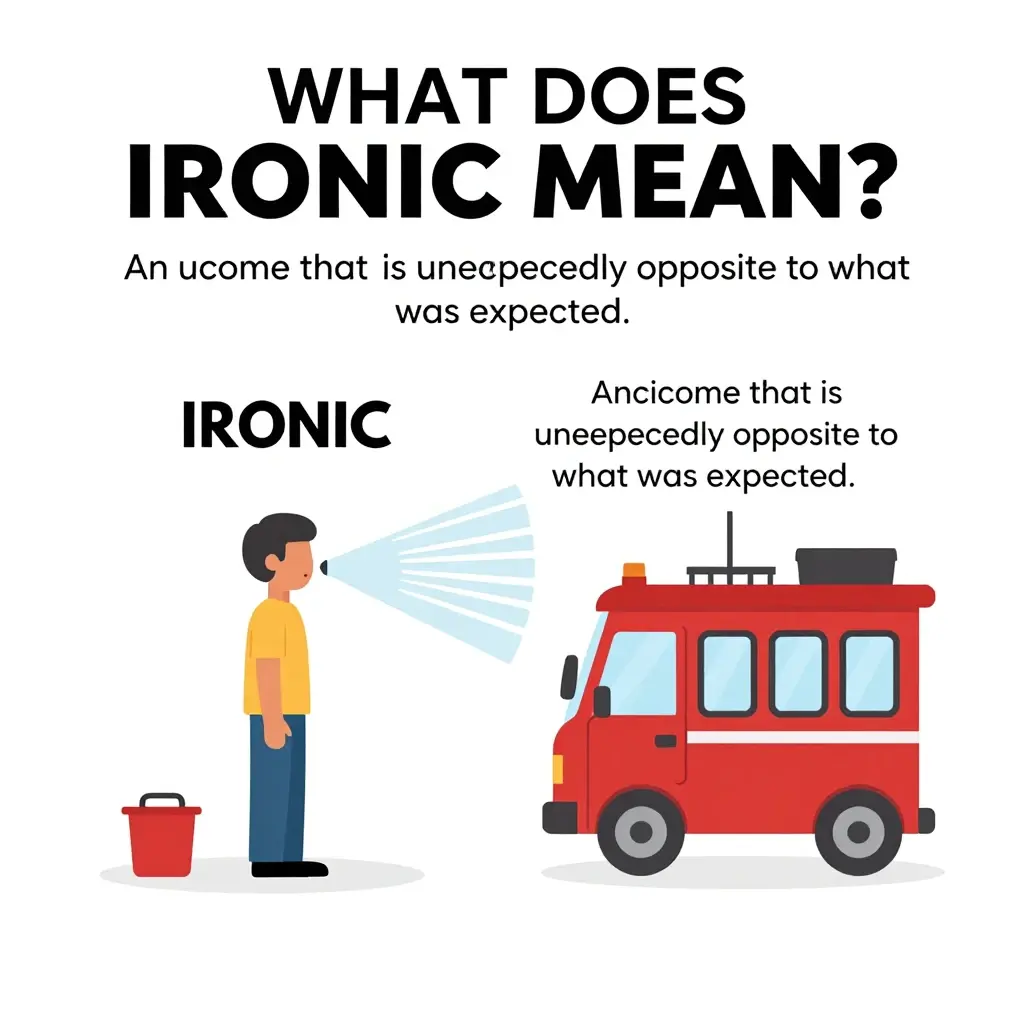
The word ironic comes from irony, a literary and everyday concept involving contrast between expectation and reality.
Something is ironic when:
- The outcome is unexpected.
- The result is the opposite of what people anticipated.
- There is a contrast between appearance and reality.
Examples
- “A firefighter’s house caught fire.”
- “A traffic police officer got a speeding ticket.”
These situations are considered ironic because they contradict what people would normally expect.
What Does Ironic Mean in Everyday Conversation?
In daily life, people often use ironic to describe surprising or unexpected situations.
Examples
- “It’s ironic that I forgot my phone while going to buy a phone case.”
- “She teaches cooking but burned dinner.”
Sometimes people use ironic loosely to mean “unexpected,” though technically not every surprising event is irony.
What Does Ironic Mean in Literature?
In literature, irony is a writing technique used to create humor, suspense, or deeper meaning.
The three main types are:
1. Verbal Irony
A person says one thing but means another.
Example:
Saying “Great weather!” during a heavy storm.
2. Situational Irony
The outcome is opposite to what was expected.
Example:
A police station being robbed.
3. Dramatic Irony
The audience knows something that a character does not.
Example:
In a movie, viewers know the villain is hiding in the house, but the main character doesn’t.
What Does Ironic Mean in Texting?
In text messages, ironic usually describes something amusing or unexpectedly contradictory.
Examples
- “It’s ironic that my phone died while I was looking up battery-saving tips.”
- “How ironic! 😂”
What Does Ironic Mean in Love and Relationships?
In relationships, ironic can describe unexpected situations.
Examples
- “They met after saying they’d never date anyone from work.”
- “It’s ironic that they became friends after years of rivalry.”
The word highlights an unexpected twist.
What Does Ironic Mean in Slang?
Ironic is not slang, but people sometimes use it casually to describe anything surprising or humorous.
Strictly speaking, ironic should involve a contrast between expectation and reality, not just coincidence.
What Does Ironic Mean on Social Media?
On platforms like TikTok, Instagram, X (formerly Twitter), Reddit, and Facebook, ironic often appears in:
- Memes
- Jokes
- Viral videos
- Pop culture discussions
People may say something is “ironically funny” when it’s amusing because it’s unexpected or intentionally exaggerated.
Does Ironic Have a Spiritual Meaning?
No.
Ironic has no specific spiritual or religious meaning.
It is primarily a literary and conversational term.
Does Ironic Have a Cultural Meaning?
Yes.
In movies, television, books, and comedy, irony is widely used to entertain audiences and encourage deeper thinking.
Writers, comedians, and filmmakers often use irony to:
- Create humor.
- Highlight contradictions.
- Surprise audiences.
- Make social commentary.
Examples and Usage
Here are some everyday examples of ironic.
Work
“It’s ironic that the computer technician’s laptop stopped working.”
School
“The teacher forgot to bring the homework.”
Weather
“It’s ironic that the umbrella store flooded after heavy rain.”
Social Media
“People called the situation ironic because the result was the exact opposite of what everyone expected.”
How Context Changes the Meaning of Ironic
| Context | Meaning |
| Everyday conversation | Unexpected contrast |
| Literature | Writing technique using irony |
| Comedy | Humorous contradiction |
| Social media | Funny or surprising situation |
| Texting | Unexpected or opposite outcome |
The core idea always involves a contrast between expectation and reality.
Similar Words to Ironic
Here are some related words:
| Word | Meaning |
| Unexpected | Not anticipated |
| Contradictory | Opposite in nature |
| Sarcastic | Mocking through words (sometimes uses verbal irony) |
| Coincidental | Happening by chance (not always ironic) |
| Paradoxical | Seemingly contradictory but possibly true |
Although these words are related, they are not exact synonyms.
How to Reply When Someone Says “That’s Ironic”
If someone says:
“That’s ironic.”
You could reply:
- “Yeah, I didn’t expect that!”
- “The outcome was the complete opposite.”
- “That’s a funny twist.”
The response depends on the situation being discussed.
Common Mistakes About Ironic
Myth 1
Everything unexpected is ironic.
False.
An event is only ironic if there’s a meaningful contrast between what was expected and what actually happened
Myth 2
Irony and coincidence are the same.
False.
A coincidence is simply an unexpected event, while irony involves an opposite or contrasting outcome.
Myth 3
Ironic always means funny.
False.
Irony can be humorous, serious, tragic, or thought-provoking.
FAQs
Q1. What does ironic really mean?
A: Ironic means something happens in a way that is opposite to what was expected, creating a contrast between expectation and reality.
Q2. Is ironic positive or negative?
A: It can be positive, negative, or neutral, depending on the situation.
Q3. Is ironic romantic?
A: No. It is not a romantic term, although it can describe unexpected events in relationships.
Q4. How should someone reply when they hear “That’s ironic”?
A: You can reply, “I didn’t see that coming,” “That’s quite unexpected,” or “What a twist!”
Q5. Is ironic commonly used on social media?
A: Yes. It is frequently used in memes, jokes, discussions, and commentary about unexpected situations.
Q6. How do you pronounce ironic?
A: It is commonly pronounced eye-RON-ik.
Conclusion:
Ironic describes a situation where the outcome is opposite to what people expect, creating a contrast between expectation and reality.
It is widely used in everyday conversations, literature, comedy, and social media to describe surprising, humorous, or thought-provoking events.
Understanding the difference between irony and coincidence will help you use the word more accurately.
Now that you understand the meaning of ironic, you’ll be able to recognize irony in conversations, stories, movies, and everyday life with greater confidence.

Brandon Lewis researches modern vocabulary and semantic trends to create informative, reader-focused language guides.